Te Morenga
Te Morenga of Taiāmai was a major rangitira and war leader, in many ways the rival to Hongi Hika. In 1818 and 1820 he led his own taua to the Bay of Plenty and the East Coast, and came home the second time with a peace. He was Samuel Marsden's closest Māori friend, Hongi's rival on the inland plains, and one of the first Bay rangatira to fight a musket war far from home. Percy Smith called him probably the greatest Māori chief of the early nineteenth century.
Hapū/Te Uri Kāpana and Te Ngare Hauata
Taiāmai is the volcanic plain of the inland Bay of Islands, around Pouērua, Pakaraka and Ōhaeawai. Ngāpuhi hapū took it from Ngāti Pou in the late 1700s. Ballara names Te Morenga's father, Whāingaroa of Te Ngare Hauata, among the chiefs who fought in that conquest, when four Ngāti Pou pā fell one after another.
In his 1966 Encyclopaedia entry, B. J. Foster calls Te Morenga the principal chief of Te Uri Kāpana, with his pā at Taiāmai. Ballara names his people as Te Uri Kāpana and Te Ngare Hauata, and Stokes's evidence for those two hapū in the Te Raki inquiry agrees and names Iwi as his brother. Anne Salmond's map of Bay chiefs for 1805 to 1815 labels his group Ngāti Hine. My data follows Henare, Petrie and Puckey and runs his line from Hineāmaru, the founder of Ngāti Hine, through Pera, Waipihangārangi, Moraki and Te Hore to Whāingaroa. Salmond and the Tribunal evidence may describe the same descent from two angles, and I'd welcome a correction from anyone who knows.
Te Uri Kāpana sat in the southern half of the Bay's politics. Foster writes that Te Morenga and Hongi were "exceedingly jealous of each other", though they fought on the same side when their kin needed them. In 1819 Te Morenga and the other Taiāmai chiefs complained to Marsden that the missionaries were putting the iron trade into Hongi's hands.
Rangatira/Te Morenga
The Venus
In 1806 convicts seized the brig Venus and sailed her to New Zealand. At the Bay of Islands they carried off women of rank. They left Te Morenga's niece Tawaputa in the Bay of Plenty, where Ngāi Te Rangi of Tauranga killed her. His sister died soon after at the hands of Ngāti Porou at the East Cape. Foster and Scholefield both call Tawaputa his niece, and I'll follow them.
Custom and his father's dying charge laid the debt on Te Morenga. Foster records that he sent spies dressed as traders into both districts to learn what had happened, and then waited for years. Ballara describes the take as "the kidnapping of women of rank, their immediate kin, by the crew of the Venus", and adds that the Bay's new strength in muskets made the answer possible. In the meantime he fought at Moremonui in 1807, and Ballara counts four wars he took part in before 1820 for utu over that defeat.
Marsden
Te Morenga met Marsden in 1814, sailed with him to Te Haupa at Thames in January 1815 as his interpreter, and spent time at Parramatta with Te Pēhi. Marsden described him as a man of "very sound and deep reflection", and J. R. Elder credits him with much of what Marsden wrote about Māori custom. He pressed Marsden for a teacher, and in 1820 Marsden sent James Shepherd to live with Te Uri Kāpana at Taiāmai. He asked the missionaries to teach only chiefs and their sons.
The taua
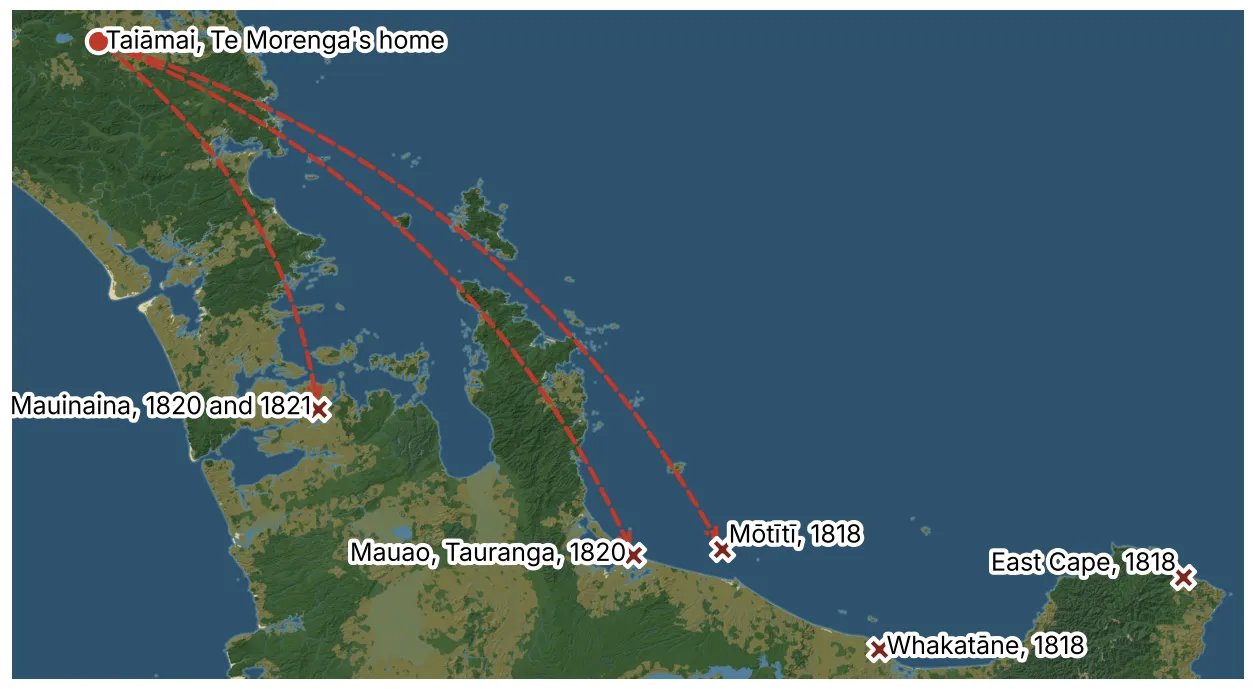
- January 1818: Te Morenga sailed with about 400 men. At Mōtītī Te Waru was away, and Scholefield records that Te Morenga killed his uncle Te Tawhio. At Whakatāne the taua chased Ngāti Awa inland to Okahukura pā and fell back after heavy losses. On the East Cape he fought a long campaign against Ngāti Porou and came home late in the year with prisoners.
- December 1819: Te Morenga's people and Hongi's fought at home. Scholefield names a dispute over the potato crop at Kerikeri, and Ballara a theft of pipi from a tapu place, with two dead on Hongi's side and eight on Te Morenga's.
- January 1820: Te Morenga went back to Tauranga with about 600 men and 35 muskets. The first volley killed Te Waru's father and others, and Foster writes that Te Morenga thought the debt paid. His allies insisted on pursuit. He sent to Te Waru's women to ask whether Te Waru would make peace, and the answer came back no. In the second fight Te Waru lost about 400 dead and 260 captured. Te Morenga found him in the bush and took his submission, and gave him a musket as utu for his father. The taua reached the Bay on 2 March with 50 canoes, and on 10 March Major Cruise saw Te Uri Kāpana bring a canoe to Hongi's people to make peace.
- July 1820: Te Morenga went with Marsden to Tauranga, where Marsden helped turn the truce with Te Waru into a lasting peace. Ballara records an exchange of high-ranking hostages.
- 1820 and 1821: Ngāti Pāoa killed Koperu, Te Morenga's kinsman, at Mauinaina. Te Morenga attacked the pā late in 1820 and failed. In 1821 he joined Hongi's great taua, which took it, and then the siege of Te Tōtara.
He followed Hongi to Mokoia in 1823 and Pōmare into Te Urewera, and fought at Te Ika-a-Ranganui in 1825. After that he kept out of most quarrels and turned to wheat and mills. Two of the girls at the centre of the Girls' War in 1830 were his kin, and he brought his people from Taiāmai to stand with Kiwikiwi until the chiefs made peace in March. In 1831 he signed the chiefs' letter to William IV. In 1833 he sold land at Pakaraka to Henry Williams. Williams last saw him at Waitangi on 3 December 1834, ill and set on travelling to Waimā, and he died a few days later.
Playthrough/Haerenga taua and utu
Of the game's systems, I lean on utu and the haerenga taua hardest here. His story moves from an open account to an expedition to a peace, and I need the ledger to carry all three.
The start
In January 1810 I seat Te Morenga at Taiāmai, with Iwi on the roster beside him. Rangatira of several hapū share the Taiāmai kāinga: Te Wera Hauraki of Ngāti Hineira, Tamati Pukututu of Te Uri o Hawato, and others. Ngāti Rangi seats at Ōhaeawai and Te Ahuahu hold about 400 more. My data gave Te Morenga's own seat only about 35 people, too few for a man who took 400 men south in 1818. I've raised it to about 400, and with his Ngāti Rangi kin and allies he can now fill the waka.
The records disagree in two places worth naming. Scholefield puts his return from the East Cape early in 1819 and Foster in November 1818, and Scholefield dates his death to early 1834 against Foster's December. NZHistory lists a "Timorenga" as the 47th signatory of He Whakaputanga, and suggests his son Kihiringi signed in his name in 1837. Readers there argue that two men, this Te Morenga and Haare Nepia Te Morenga of Ahipara, have been run together. My data keeps them apart, and places Kihiringi as the son of the Ahipara man.
Utu
Te Morenga starts the game with two personal accounts, one against Te Waru for Tawaputa and one against the East Coast for his sister. Personal utu sits on top of the hapū ledger, tilts a rangatira's choices and passes to his heir. A dying rangatira's ōhākī can bind the hapū to an account, which fits Whāingaroa's charge to his son.
Under the ledger rules an obligation costs no mana while the holder waits for the means. In 1810 Te Morenga has neither the muskets nor the fleet to reach Tauranga, so the accounts sit quiet. They start to drain once they run overdue, or when someone raises them in public. I want the spies to work as the player's tool for those years: news of the women's fate, and of the enemy's strength, before the muster.
Haerenga taua
A taua needs a muster before it needs a destination. Kin answer when fetched, and non-kin want feasts, pounamu, guns and a share of the plunder. A large taua needs a garden planted the season before. Once the taua musters, a tohunga makes it tapu, and its people keep the restrictions until they come home.
The rules weigh rank over numbers. At Mōtītī Te Morenga killed Te Waru's uncle, and Te Waru escaped, so the account stayed open. In the game the player reads the score as war parties once did at dusk, and learns whether the dead on each side are even enough for peace.
Tauranga in 1820 is the case I'm designing toward. Te Morenga read the score after the first volley and judged it even. His allies read it another way, and they had come for spoils. Under the alliance rules allies expect plunder in proportion to what they brought, and I want a leader who stops too early to pay for it in their loyalty. The musket he handed Te Waru for his father closed the last open account between them, and a generous gesture from strength raises mana under the rules.
At home
The 1819 quarrel tests the kin side of the rules. Te Morenga's people and Hongi's were kin, and a dispute over food between kin should end in muru. Eight deaths turned it into a war. Under the kin rules the fighting stays capped, and a canoe can close it. A Te Morenga player has to keep one eye on Tauranga and the other on Waimate.
If you hold kōrero about Te Uri Kāpana, Te Ngare Hauata or Te Morenga that differs from what I have here, I want to hear it.
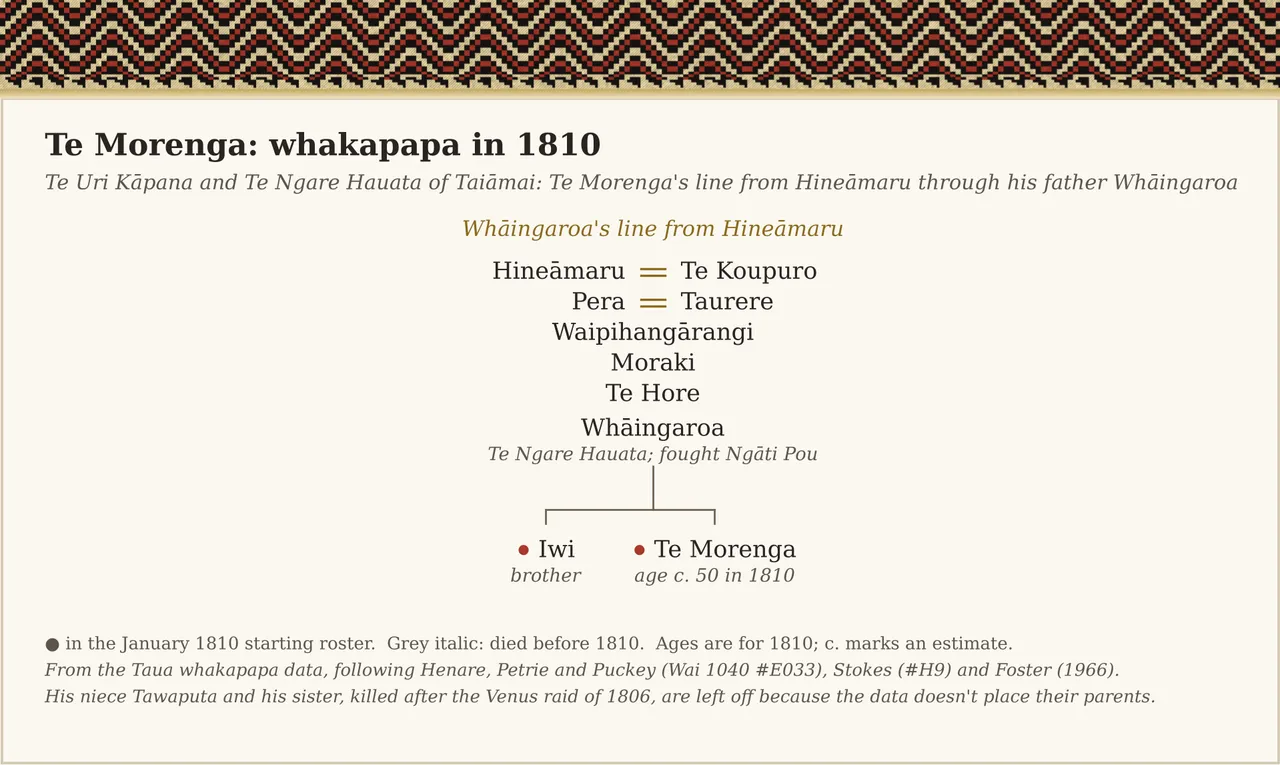
Image credits
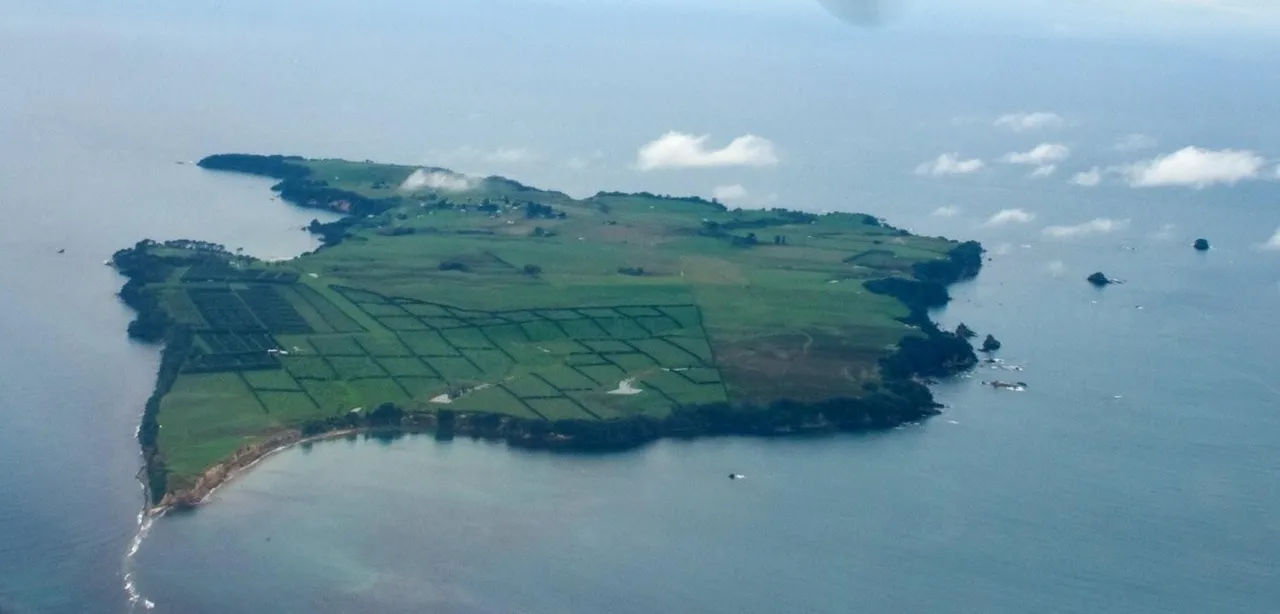
- Phillip Capper, Motiti Island, Bay of Plenty, 2008. CC BY 2.0, via Wikimedia Commons.
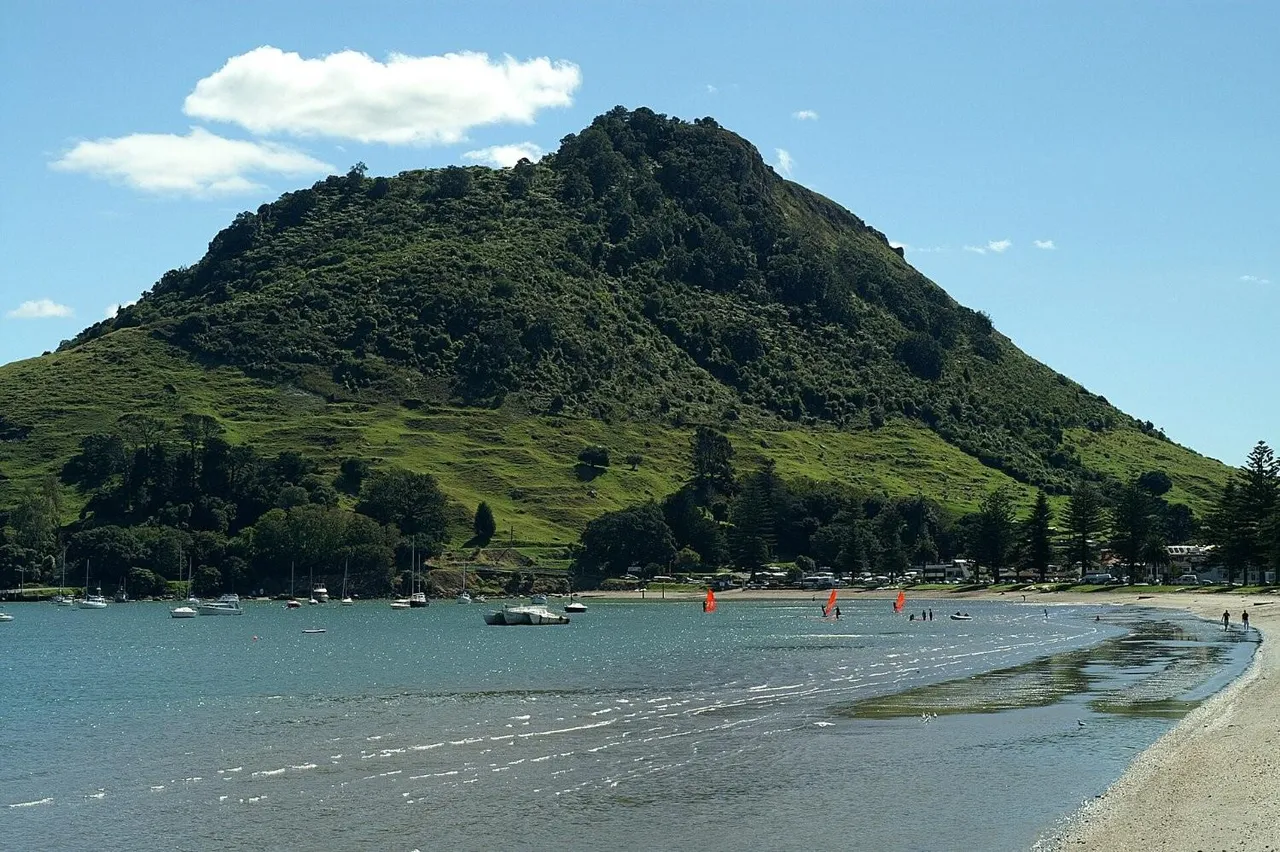
- Alexander Klink, Mount Maunganui near Tauranga, 2006. CC BY 3.0, via Wikimedia Commons.
- Map and whakapapa chart: Taua data and base map.
Sources
- B. J. Foster, "Te Morenga", An Encyclopaedia of New Zealand, ed. A. H. McLintock, 1966. Te Ara.
- G. H. Scholefield, "Te Morenga", Dictionary of New Zealand Biography, vol. 2, 1940, p. 53.
- "Te Morenga", He Whakaputanga signatories, NZHistory, Manatū Taonga.
- Angela Ballara, Taua: "Musket Wars", "Land Wars" or Tikanga?, 2003.
- R. D. Crosby, The Musket Wars: A History of Inter-Iwi Conflict 1806 to 1845, 1999.
- Henare, Petrie and Puckey, "Ko Te Tino o Taiamai", Wai 1040 #E033, 2009.
- Stokes, evidence for Ngāre Hauata and Te Uri Kāpana, Wai 1040 #H9.
- Anne Salmond, Between Worlds: Early Exchanges between Maori and Europeans, 1773 to 1815, 1997.
Comments