Hōne Heke Pōkai
In January 1810 Pōkai was a baby at Kaikohe, named for an uncle killed at Moremonui. Thirty years later he signed the Treaty of Waitangi before any other northern chief. Four years after that his men cut down the flagstaff at Kororāreka, and he spent the next two years fighting the Crown and his own kin. This post looks at his people in 1810 and at the man he became.
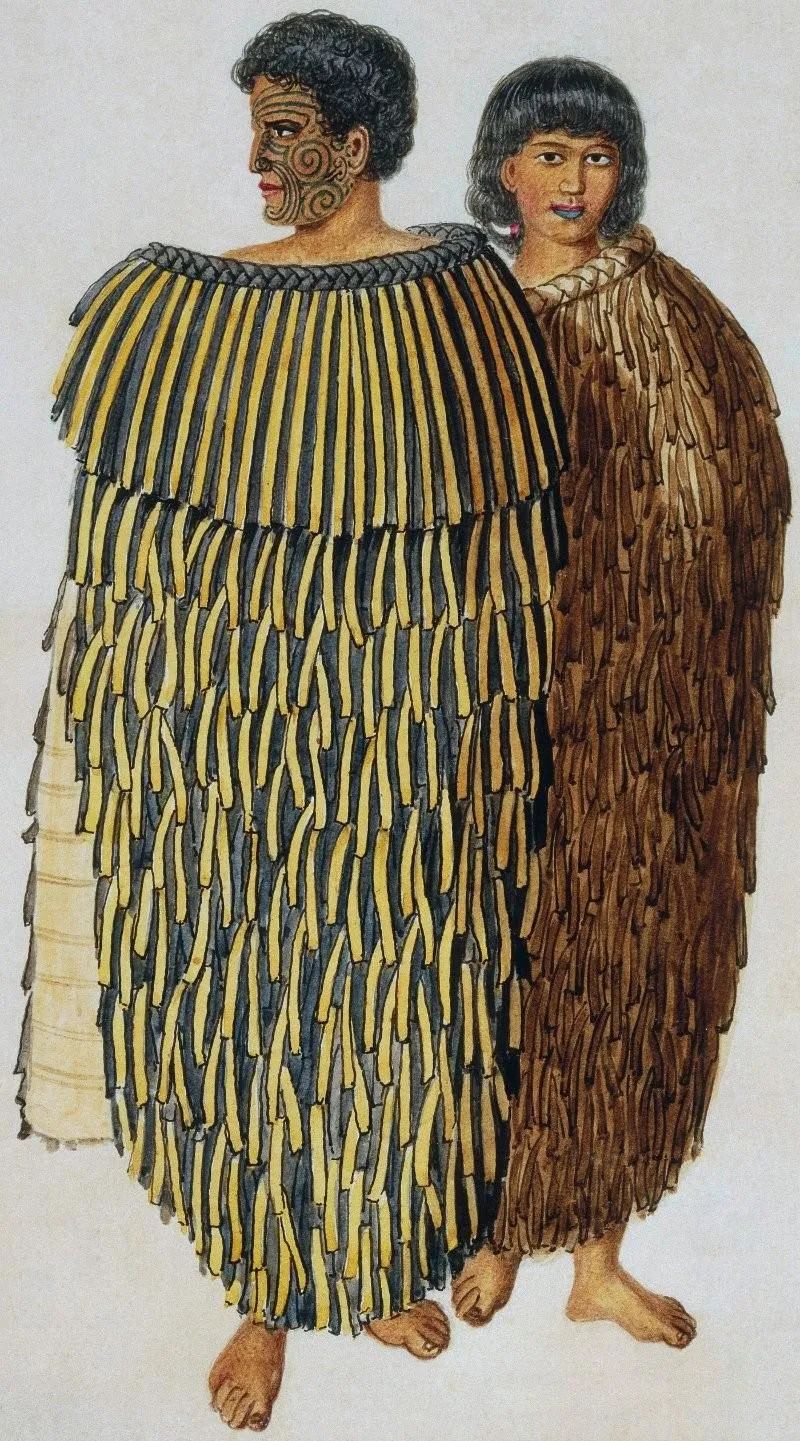
Hapū/Ngāti Rāhiri and Te Matarahurahu
Freda Rankin Kawharu's biography gives Heke's affiliations as Ngāpuhi, Ngāti Rāhiri, Ngāi Tāwake, Ngāti Tautahi, Te Matarahurahu and Te Uri-o-Hua. His senior descent gave him rights of use, control and trusteeship from Kaikohe to Waimate North, Pākaraka, Waitangi, Paihia and Te Rāwhiti. Ngāti Rāhiri held the inland country around Pouērua and Pākaraka and the coast at Waitangi, and I carry them in the game as several hapū across those places.
His parents were Tūpanapana and Te Kona, and he was their third child. Kawharu names two elder brothers, Tuhirangi and Peia, and a sister, Taingarui, who died young. Te Kona was the sister of Pōkaia, the war leader killed at Moremonui in 1807 or 1808, and Heke was born soon after and named for him. Her other brother, Te Aweawe, was the father of Ruatara, so Heke and Ruatara were first cousins in my data. Both of Heke's parents descended from Whakaaria, a son of Te Wairua, the ancestor Heke shared with Hongi, Rewa and Patuone's mother Te Kawehau.
The sources split on two links. Crosby calls Pōkaia Heke's father, and I've kept Kawharu's reading. Kawharu places Kauteāwhā of Ngāti Rāhiri, Heke's great-grandfather, on his father's side, where my data has him on his mother's. I'd welcome help from anyone who holds this whakapapa.
When Heke was a baby in arms, a Ngāti Whātua taua sacked Pā Te Oro, one of Pōkaia's pā on Kaikohe hill. The raiders took Heke and Te Kona and tied them to a pūriri at the place now called Te Herenga. Hongi's father Te Hōtete crept up on their captor and held a mere to his head until he let them go. Te Kona took her son to refuge at Pakinga.
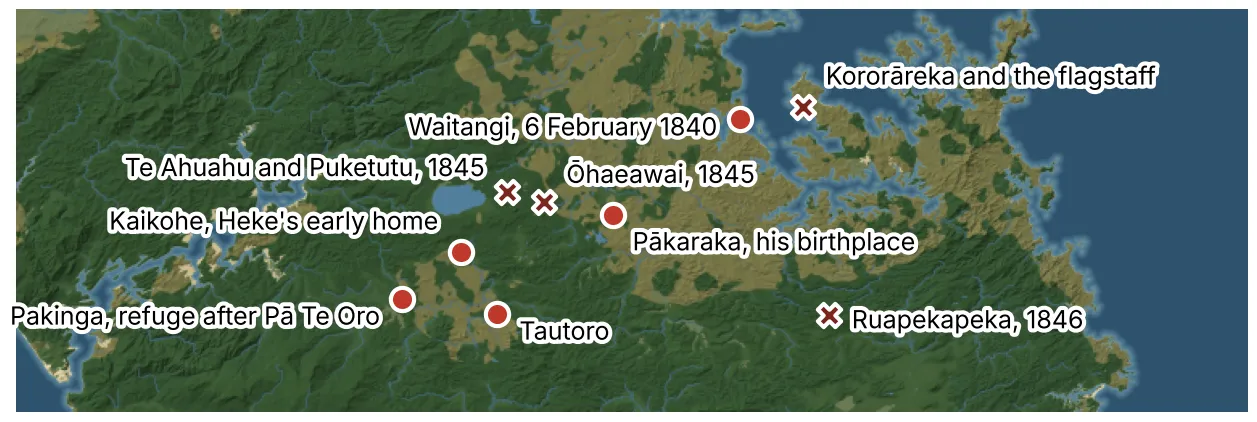
Rangatira/Hōne Heke Pōkai
As a third son Heke lacked a first-born's authority, but his descent from Rāhiri gave him mana beyond dispute, and he built on it with his own energy. He attended the mission school at Kerikeri in 1824 and 1825, where the missionaries found him quick, mischievous and sometimes surly. Henry Williams became something like a father to him while he lived at Paihia. Heke married Ono, a daughter of Te Pahi, and Henry Williams's mission baptised them on 9 August 1835. He took the names Hōne and Wiremu, though he kept using Pōkai. Ono died soon after, and their two children did not survive. On 30 March 1837 he married Hariata Rongo, Hongi's daughter, in the Kerikeri chapel.
He stayed a fighter through his Christian years. He fought his first battle on the beach at Kororāreka in the Girls' War of 1830, took a wound on Tītore's expedition to Tauranga in 1833, and fought against Pōmare II at Ōtūihu in 1837.
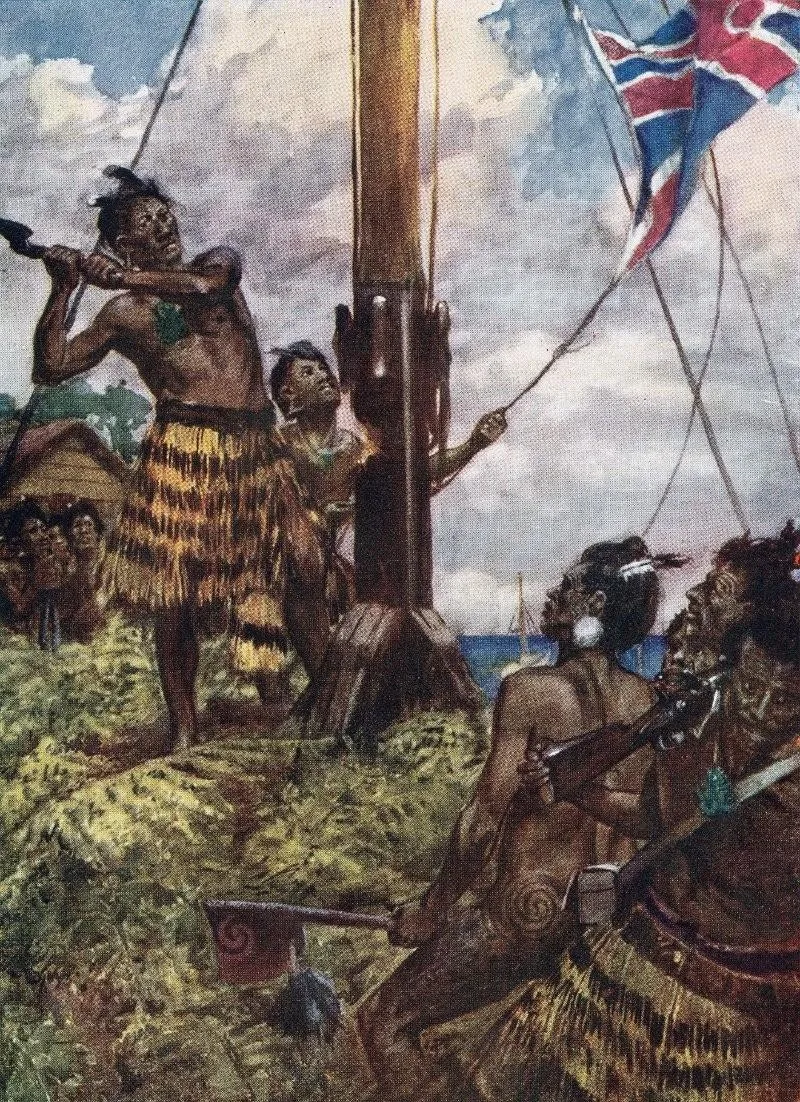
On 6 February 1840 Heke signed the Treaty first. Kawharu writes that the chiefs who signed the Māori text believed it protected their rights and guaranteed their rangatiratanga. Within a few years the Bay's economy sagged. The capital moved to Auckland, customs duties pushed up prices, shipping levies went to the government, and land sales slowed under Crown control. In 1842 the Crown tried and hanged Maketū, son of the northern chief Ruhe, and Heke read it as chiefly authority giving way to the Crown's. He fixed on the flag over Kororāreka, on a staff he had once given to fly a Māori flag.
- 8 July 1844: Te Haratua, Heke's second in command, led the men who cut the flagstaff down at dawn.
- 9 and 10 January 1845: Heke cut down its replacement, and again on 19 January.
- 11 March 1845: with Kawiti and Te Kapotai drawing off the garrison, Heke's men felled the staff a fourth time. HMS Hazard shelled the town after its people left, and men from both sides looted it. Heke drew a line south of the town and ordered his men to leave everything beyond it alone.
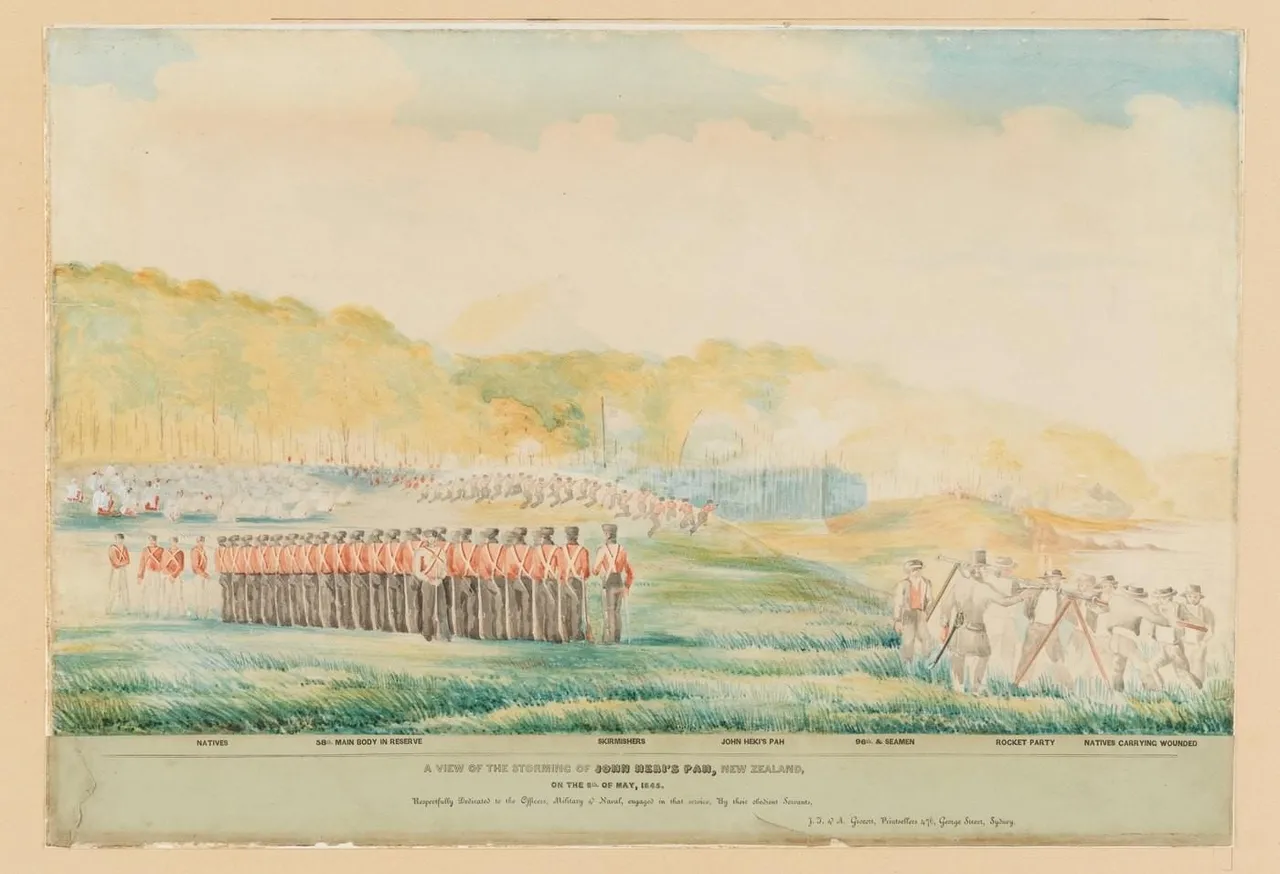
- 8 May 1845: at Puketutu near Lake Ōmāpere, Heke's pā held against Colonel Hulme's 460 soldiers, marines and volunteers, and Hulme withdrew.
- June 1845: Makoare Te Taonui, Nene's ally, took Te Ahuahu while Heke was away. Heke fought to get it back, and took a severe wound to the thigh.
- January 1846: he joined Kawiti at Ruapekapeka with 60 men on 10 January. The defenders withdrew, and Kawharu argues they planned it, hoping the troops would follow them into the bush.
Through his recovery, Heke fought with letters. He told FitzRoy his quarrel lay with the government, and the settlers were welcome. To Governor Grey he wrote: "God made this country for us. It cannot be sliced; if it were a whale it might be sliced." A week after Ruapekapeka, Heke, Kawiti and Nene met at Pōmare II's pā and agreed to seek peace. Grey issued a pardon and took no land. Heke refused to come to Grey as a supplicant, and the two first met in 1848, when Heke gave him a greenstone mere. Kawharu reads the gift as acceptance of the governor's place and a charge to honour the Treaty.
Kawharu rejects the old claim that Heke left the war a broken man. His mana grew, and he went on settling disputes among his people at Tautoro and Kaikohe while tuberculosis wore him down. He died on 6 August 1850, and his people buried him in secret among his tūpuna at Pākaraka.
Playthrough/The Treaty and resistance
Of the game's systems, I lean on the Treaty and the Crown hardest here, though the player waits thirty years to reach them. The player's choices before 1840 shape the rangatira who arrives at Waitangi.
The start
In January 1810 Heke is about three, and the player leads his people until he grows into the role. Ngāti Rāhiri ki Pakaraka hold Pouērua, Ngahuha, Oromahoe and Pākaraka, about 785 people across four kāinga, and Heke's own hapū Te Matarahurahu holds Te Tii under Te Hauā Taihotahota. Te Kona, her brothers Te Aweawe and Kahuwaero, and Heke's brothers Tuhirangi and Peia sit on the roster with the child.
Writing this post, I found a gap at the top. My data left the seat at Pākaraka empty, and Tūpanapana, named in an old file as leader, dies around 1809 in my roster. I've added Heke's brothers and sister from Kawharu's biography and seated Tuhirangi at Pākaraka. No source I've read names the 1810 holder, and by my estimate Tuhirangi is about fifteen, so the hapū starts with a young rangatira and a regency question. I've kept the baby at Pākaraka with his family, though Kawharu puts his early years at Kaikohe and Pakinga. I'd like the raid on Pā Te Oro as an early event: a Ngāti Whātua taua, a mother and child held at Te Herenga, and Te Hōtete's rescue.
Growing a rangatira
Mana comes first from descent and then from deeds, and a third son starts behind his brothers on the first count. Heke made up the gap with war, oratory and the mission. The mission school is where the game's knowledge system matters here. A rangatira taught by missionaries gains literacy, and a literate rangatira can take Treaty options the others lack. Heke read scripture, preached as a lay reader and wrote to governors. I want his letters to work as a tool in the game, a way to press the Crown when the guns are quiet.
The Treaty event
The Treaty arrives in a window around 1840, and the player can delay it but has no way to stop it. The design gives five responses: sign from strength, sign from weakness, negotiate clause by clause, refuse, or lead the negotiation for others. Negotiating clause by clause needs a literate rangatira who can read the difference between kāwanatanga in the Māori text and sovereignty in the English one. Heke signed first, and that is the historical default for this start.
The years after are where I want the cost to show. Moving the capital, customs duties and the shipping levies should hit the Bay's trade in ways the player can see in the stores, the way Heke's people saw it in prices. A rangatira who signed for protection and then watches his economy shrink should feel the gap between what he signed and what he got.
Resistance
Heke aimed his war at the Crown and its flag, and he protected the settlers. I want cutting the flagstaff to run on the same logic as the symbolic acts in the utu rules, where a gesture carries a message without a killing. The colonial force arrives as an event once land sales, the Treaty outcome and European strength in the region pass a threshold, and open violence against Europeans brings it faster. Heke's line south of Kororāreka and his care for the settlers should slow that response, and the player should feel the difference.
The hardest part of this path is Nene. The design calls kūpapa the most dangerous part of a colonial force, because they know the land and fight the way you do. For a Heke player, the kūpapa are kin. Through 1845 the two sides fought by day and sometimes paused by agreement, and I want the kin rules to hold inside that war. The war ended without confiscation, and a player who fights it the way Heke did should come out of it with more mana than he took in.
If you hold kōrero about Ngāti Rāhiri, Te Matarahurahu or Hōne Heke that differs from what I have here, I want to hear it.
Next up is Te Whareumu and Kiwikiwi of Ngāti Manu at Kororāreka.
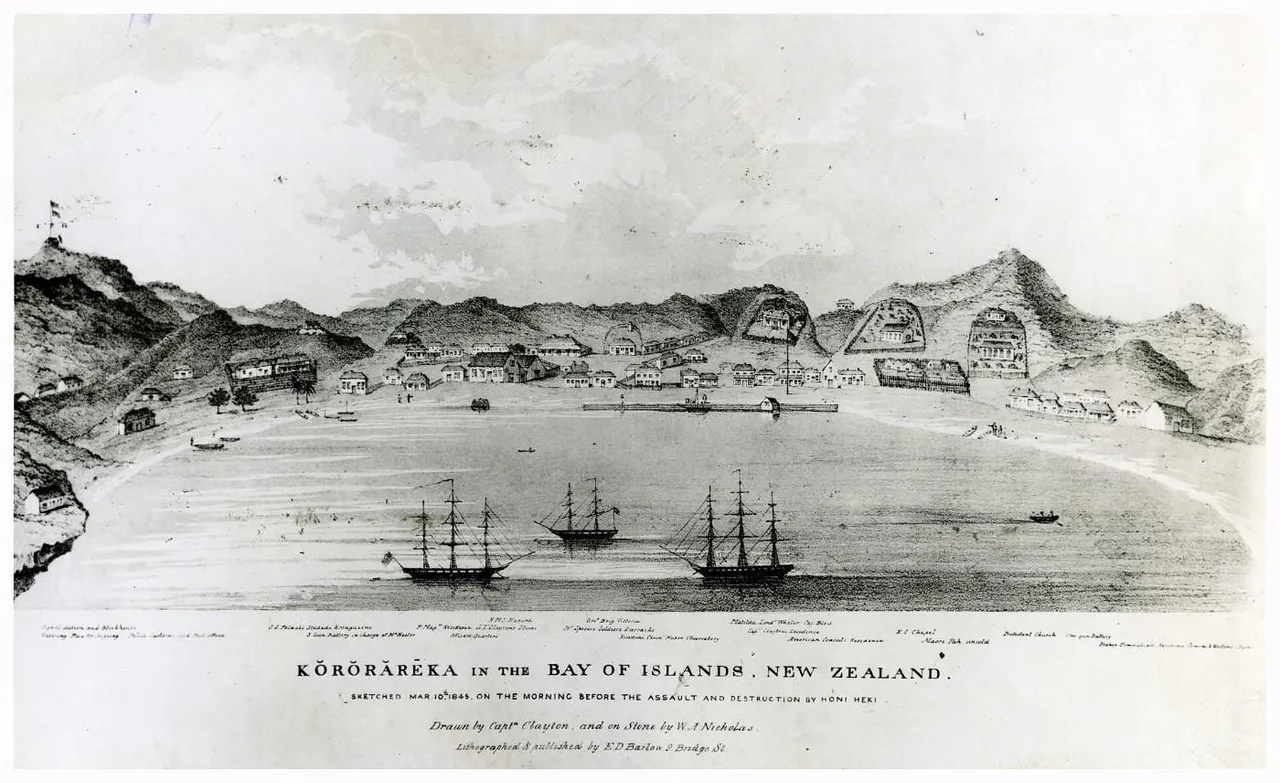
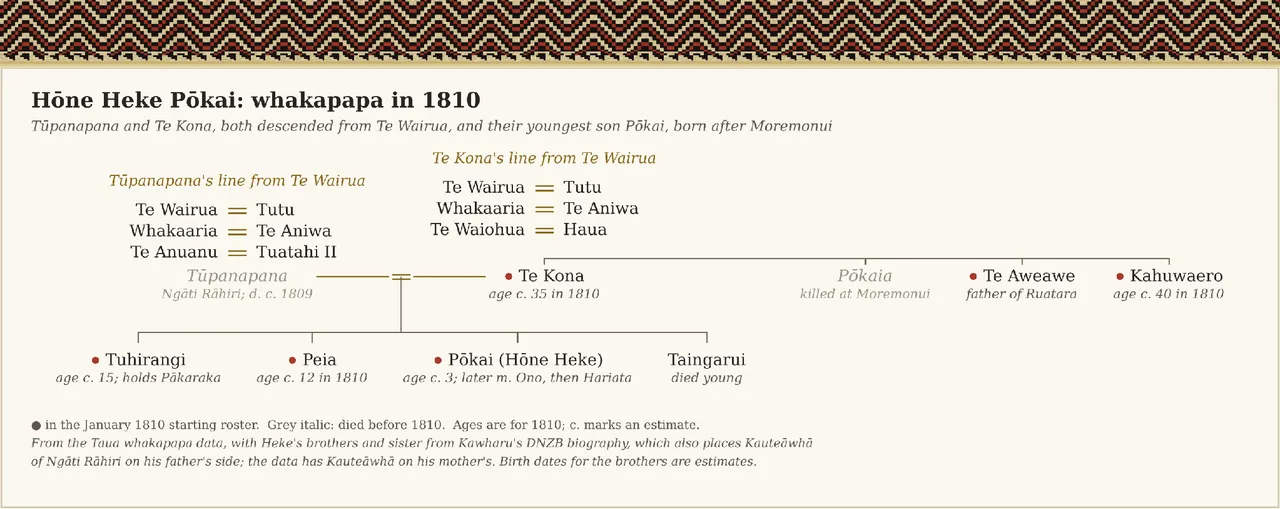
Image credits
- Joseph Jenner Merrett, Hōne Heke and Hariata, about 1845. Alexander Turnbull Library, E-309-q-2-033. Public domain, via Wikimedia Commons.
- Arthur David McCormick, Heke fells the flagstaff at Kororāreka, 1908. Alexander Turnbull Library, A-004-037. Public domain, via Wikimedia Commons.
- Unknown artist after Cyprian Bridge, Storming of John Heki's pah, 8 May 1845. State Library of New South Wales. Public domain, via Wikimedia Commons.
- Captain Clayton, Kororāreka (Russell): Before the Assault, 1845. Archives New Zealand. CC BY-SA 2.0, via Wikimedia Commons.
- Map and whakapapa chart: Taua data and base map.
Sources
- Freda Rankin Kawharu, "Heke Pōkai, Hōne Wiremu", Dictionary of New Zealand Biography, 1990.
- R. D. Crosby, The Musket Wars: A History of Inter-Iwi Conflict 1806 to 1845, 1999.
Comments