Patuone and Tāmati Wāka Nene
Patuone and his younger brother Nene of Ngāti Hao grew up fighting, and both spent much of their lives making peace and managing the Pākehā who came to Hokianga. One lived to see Auckland built. The other carried the Treaty debate at Waitangi and fought Hōne Heke for the government. In 1810 they were Hokianga war leaders with enemies on both sides of them.
Hapū/Ngāti Hao
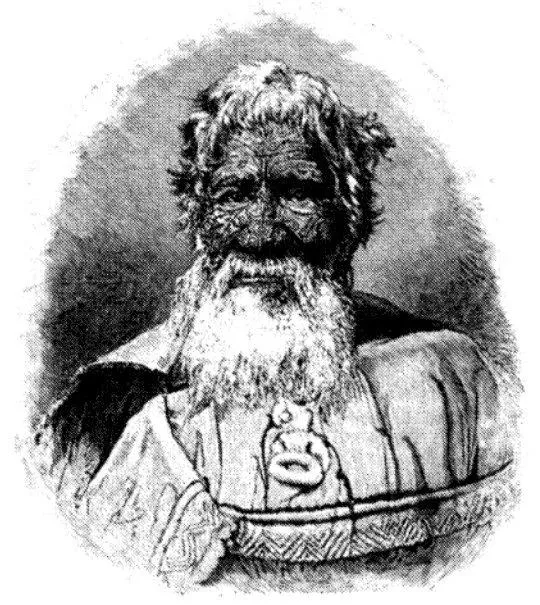
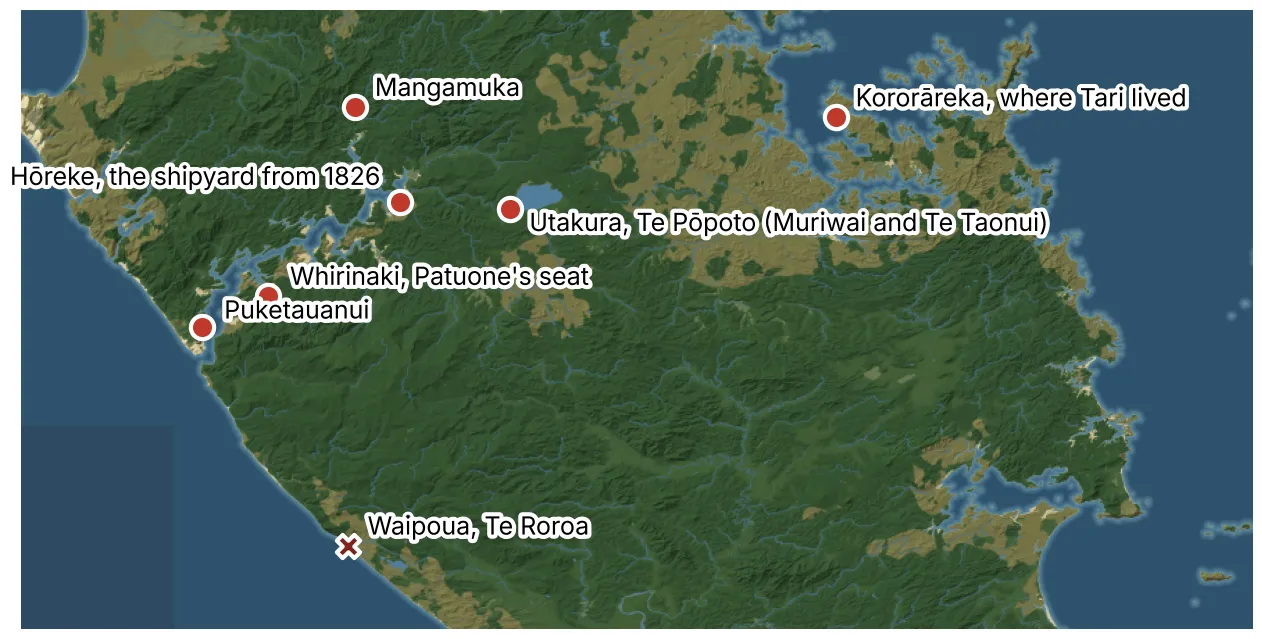
Ngāti Hao are a Hokianga hapū, on the upper harbour around Whirinaki, Hōreke and Mangamuka. Tapua, the father of Patuone and Nene, was their leader and tohunga. Through Tapua the brothers descended from Rāhiri, and my data runs that line through Te Rā and Kāmāma to Tapua's mother Ripia. Through their mother, Te Kawehau, they descended from Te Wairua, the ancestor also of Hongi Hika, Rewa and Hōne Heke. Ballara notes that marriage and descent tied the family to Ngāti Pou of Whangaroa and to Te Roroa of Hokianga and Kaipara. Their sister Tari married Te Wharerahi of Ngāi Tāwake, brother of Rewa and Moka.
Ngāti Hao take their name from an incident, not an ancestor. The family history at patuone.com says that after a massacre at Te Tōtara, an island in the Waihou River of Hokianga, the hapū's assigned role was to gather up the bones of the dead, and the "hao" in the name refers to that role. This Te Tōtara is not the Thames pā Hongi took in 1821. The same history notes that one account of the name Ngāpuhi also ties it to an event rather than a founding ancestor. If your whānau tells the Ngāti Hao story another way, I want to hear it.
Their closest neighbours were Te Pōpoto at Utakura, led by Muriwai and his younger brother Makoare Te Taonui. Ballara is clear that Patuone was not the senior chief of Hokianga. Muriwai and Te Taonui held more power, and the three families competed for traders and missionaries through the 1820s.
Tapua had two older sons, Te Anga and Te Ruanui, who fell beside him fighting Ngāti Pou at Whangaroa. Their deaths left Patuone the eldest living son, which is how Ballara describes him.
Rangatira/Patuone and Nene
Patuone was the eldest of Tapua's sons to come home from Whangaroa. He died in 1872, and estimates of his age then ran from 96 to 112. Ballara thinks he was at least 108. He remembered his father meeting Cook's ship near Cape Brett and handing him a joint of pork from the exchange. Nene was the younger brother, born around 1770 in my data.
Around 1810 Ngāpuhi and Te Roroa were at war, and the brothers fought on the Ngāpuhi side. At Waituna, around 1806, Patuone killed Tatakahuanui in hand-to-hand fighting with a greenstone adze. Nene had already fought beside Te Hōtete, Hongi's father, around 1800, when they avenged the sack of Ōkuratope by Ngāre Raumati. Relations with Hongi carried a strain. Ballara names the killing of Te Tihi, a relative of Patuone, as an account between them that stayed open.
The eighteen years after 1810:
- 1819 to 1820: Patuone led the Hokianga contingent on the long expedition south with Tūwhare of Te Roroa. From a hill above Cook Strait the leaders saw a ship, and Nene is said to have told Te Rauparaha to take the strait and trade for guns. On the way home Patuone made peace with Taranaki, returning captive children for greenstone and cloaks and arranging marriages.
- 1819 onward: Patuone welcomed the missionaries, grew wheat and may have sponsored the shipbuilding base at Hōreke. In 1826 he took the Scottish carpenters of the first New Zealand Company under his protection.
- 1822: Patuone, Nene and Muriwai took 36 axes from Thomas Kendall on behalf of Baron Charles de Thierry and put their marks on a deed for 40,000 acres. All three later said they took the axes as a gift.
- 1826 to 1827: Patuone sailed to Sydney and offered to leave his son there as a pledge that Hokianga was safe for ships. Hongi drove the Wesleyans out of Whangaroa, and Patuone escorted the missionaries to safety and brought them to Hokianga.
- 1828: Hongi died, and in the same weeks fighting at Hokianga killed Te Whareumu of Kororāreka and left Muriwai with a fatal wound. A war between Hokianga and the Bay looked certain. Patuone and Nene laid Te Whareumu's body among their own dead, and Patuone made peace with Rewa.
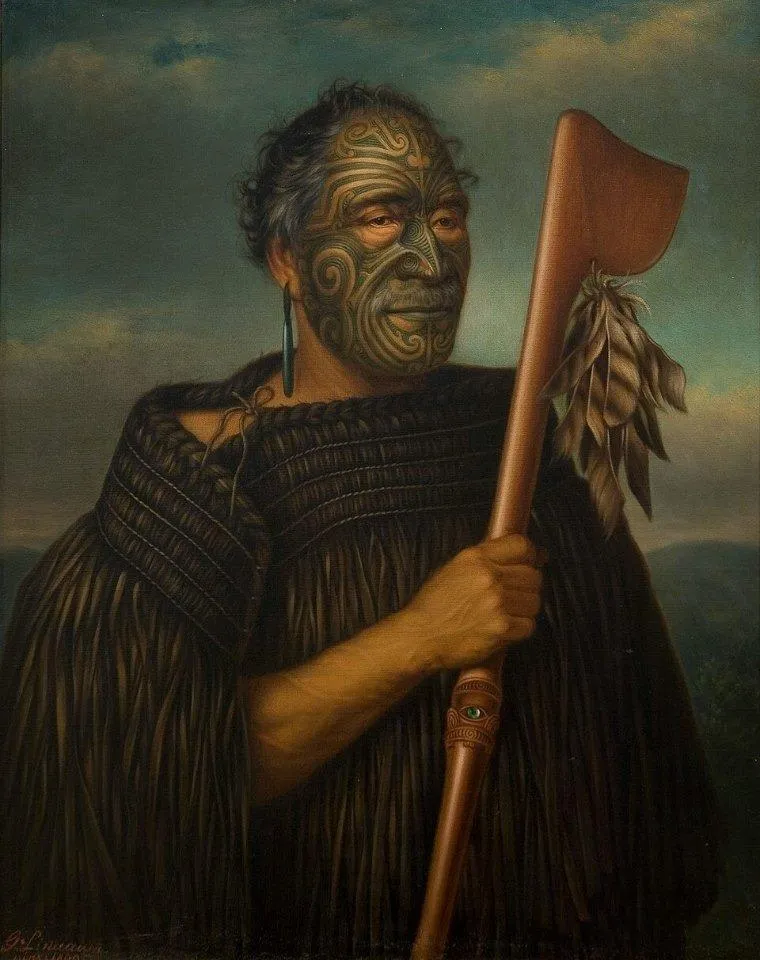
After 1828 the brothers' paths split. Patuone married Takarangi of Ngāti Pāoa and spent most of his life in the Hauraki Gulf, and later in Auckland, where his plaque calls him "Peacemaker". Nene became the leading chief of his people in Hokianga and the protector of its traders and mission. At Waitangi in February 1840 his speech carried the debate, and Ballara writes that he would not have read the Treaty as a full cession of sovereignty. In 1845 he took the field against Heke and won the one clear victory of the war, at Te Ahuahu. He died in 1871.
Playthrough/Peace-making and the Crown
Ngāti Hao is a Hokianga start with enemies to the west, a powerful kinsman to the east, and family on all sides. The system it leans on most is peace-making, and later the relationship with the Crown.
The start
In January 1810 I seat Patuone at Whirinaki, and Ngāti Hao holds Hōreke, Puketauanui, Mangamuka, Kohukohu and Omparere, about 1,200 people in my estimate. Te Kawehau, Tari and Nene sit on the roster with him. Tapua died around 1809 in my data, so the brothers start without their father. Te Pōpoto under Muriwai and Te Taonui is a separate hapū beside them, close kin and a rival for mana in Hokianga.
The ledger
The starting ledger is crowded. Ngāpuhi of Hokianga hold an account against Te Roroa for Waipuru in the Waimā valley, where Crosby records so many dead that the stream blocked. Ngāti Korokoro hold another for the killings at Opara. Hongi holds a third against Ngāti Korokoro. Crosby has them raiding Hongi's Tokerau country under Patuone and Nene in the feud of 1810 and 1811, and Hongi answering in 1813. Te Tihi's death sits underneath all of it.
Peace-making
Under the utu rules, the hapū with close kin on both sides of a dispute are the ones who can mediate. Ngāti Hao have kin on almost all sides: Te Roroa, Ngāti Pou, the Bay hapū through Te Kawehau and Tari, and later Ngāti Pāoa through Takarangi. That makes them the north's natural peacemakers, and it gives the player tools other starts lack. A peace can go through envoys or a mediator from outside the quarrel. It needs a tohunga for the karakia and food for the hosting, and it can carry a marriage or gifts of pounamu and cloaks. Patuone's 1820 peace with Taranaki, made with returned captives and marriages, is the model.
The 1828 crisis is the test I'm designing toward. Hongi's death, a killing at Hokianga and a wounded rangatira together create a moment where the systems could tip Hokianga and the Bay into war. A Ngāti Hao player who has kept their kin ties strong should be able to stop it.
The Crown
Ngāti Hao's wealth came from Pākehā on the harbour. The plot rules fix the Hōreke shipyard at 1826, and the land deals table seeds Hōreke and Mangungu, which I still need to check against the Old Land Claims. De Thierry's 36 axes show the risk built into those deals: the same transaction read as a gift by one side and a sale by the other, and the game has to let that gap open into a claim decades later.
After 1840 the Crown arrives, and Nene's path is open to the player. It pays in influence, an annuity and a governor's ear. It costs in other ways. Nene fought his own kin in 1845, and his people fell into debt when the timber trade declined. I want that path to carry both sides of the ledger.
If you hold kōrero about Ngāti Hao, Patuone or Nene that differs from what I have here, I want to hear it.
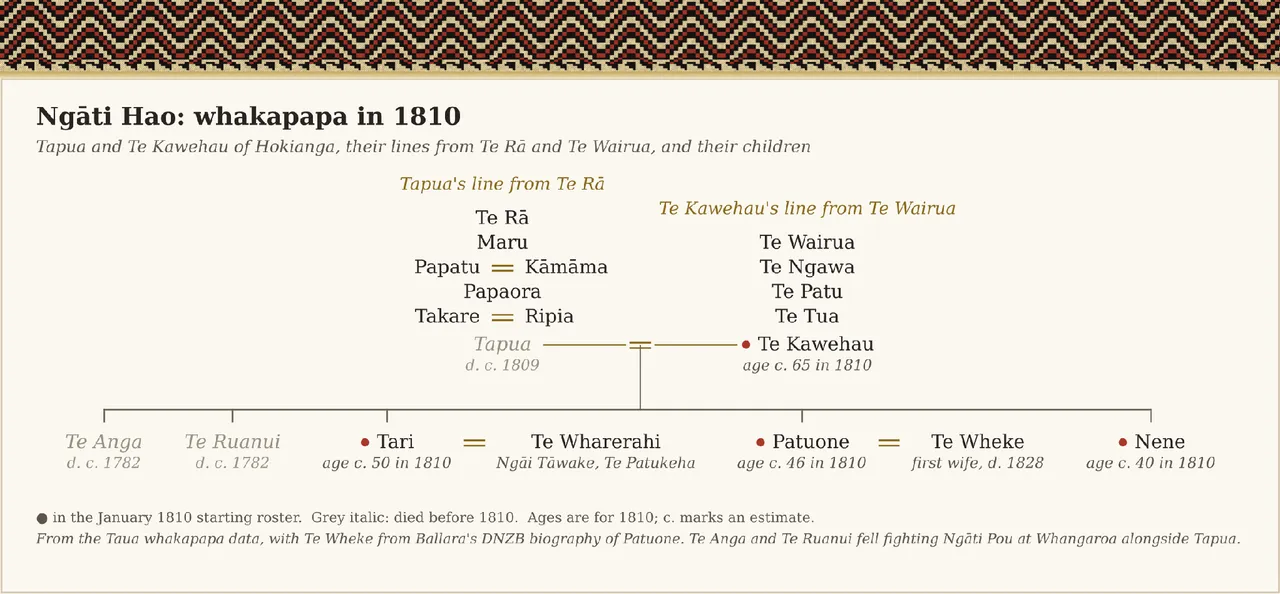
Image credits
- Augustus Earle, Patuone, from A Narrative of a Nine Months' Residence in New Zealand in 1827, 1832. Public domain, via Wikimedia Commons.
- Gottfried Lindauer, Tāmati Wāka Nene, 1890. Public domain, via Wikimedia Commons.
- Map and whakapapa chart: Taua data and base map.
Sources
- Angela Ballara, "Patuone, Eruera Maihi", Dictionary of New Zealand Biography, 1990.
- Angela Ballara, "Nene, Tāmati Wāka", Dictionary of New Zealand Biography, 1990.
- "Ngāti Hao and Ngāpuhi", Patuone: A Life, patuone.com.
- R. D. Crosby, The Musket Wars: A History of Inter-Iwi Conflict 1806 to 1845, 1999.
- Patu Hohepa, Hokianga: from Te Korekore to 1840, Wai 1040 #E036, 2011.
- Paul Monin, Hauraki Contested 1769 to 1875, 2001.
- Waitangi Tribunal, He Whakaputanga me te Tiriti (Wai 1040), 2014.
Comments