Te Ruki Kawiti
Te Ruki Kawiti of Ngāti Hine is a foundational figure in the north. He campaigned up and down the north island during the musket wars, and by the signing of the treaty was considered one of the leading rangitira in the area. In the Northern War he fought against the British, and is widely accredited as the inventor of the Gunfighter Pa. At Ōhaeawai in July 1845 his defenders threw back a storming party, and at Ruapekapeka in January 1846 his people sat out two weeks of bombardment underground. In 1810 he was a man of about 36.
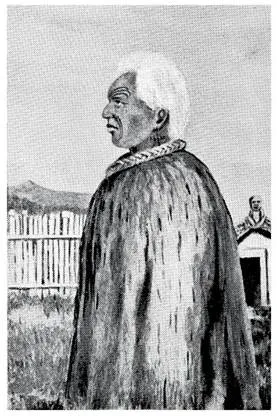
Hapū/Ngāti Hine
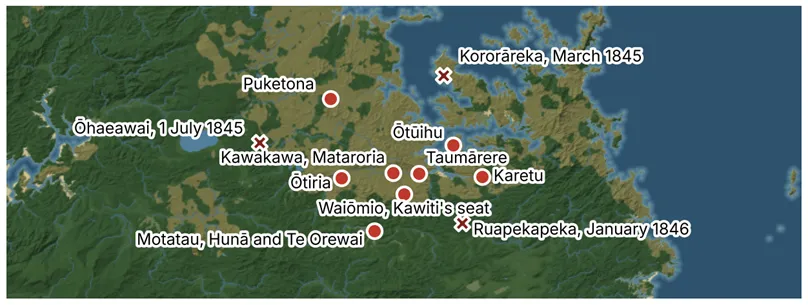
Ngāti Hine take their name from Hineāmaru, a descendant of Rāhiri, and hold the inland country south of the Bay of Islands, along the Taumārere and Kawakawa rivers and up into the hills toward Mōtatau. Martin lists Kawiti's villages as Ōtūihu, Pūmanawa, Waiōmio, Taumārere, Ōrauta and Mangakāhia, and his carved house Āhuareka stood at Waiōmio. Taumārere held a whare wānanga, and Martin writes that Kawiti trained there as a young man.
Both his parents descended from Hineāmaru. His father Hunā came down through her son Whē, and his mother Te Tāwai through her son Pera and his grandson Moeahu. Counted through his father, Kawiti stands eleven generations from Rāhiri.
The Boss Tipene notebook explains a word that confused me. Every account of Ruapekapeka calls Mataroria Kawiti's nephew, but my data has him as the son of Pakiwaha, whose mother Te Wera was Te Tāwai's half-sister. Kawiti and Pakiwaha were cousins, so Mataroria was Kawiti's irāmutu, the word that covers a cousin's child as well as a sibling's. My data had Mataroria’s birth at about 1785, which left him fathering children in his fifties and sixties. His wife Pioi was born in 1818 and their children in the 1830s and 1840s, so I've moved him to about 1795.
Te Ruki Kawiti
When Kawiti reached maturity, he was admitted into Te Whare Wānanga mō nga Tohunga, at Taumārere, one of the ancestral villages of Ngāti Hine. As he gained a reputation as a fighting warlord, Europeans gave him the nickname 'The Duke' (Te Ruki).
From his youth he was trained in leadership and warfare by Hongi Hika He fought at the Battle of Moremonui in 1807 or 1808 and as such he was part of the new wave of Ngāpuhi rangitira who would campaign up and down the north island in search of utu. Almost twenty years later, in 1825, he was at the Battle of Te Ika-a-ranga-nui when it was Ngāpuhi's turn to slaughter Ngāti Whātua in an act of utu, or revenge. He took a number of Ngāti Whātua captive and refused to hand them over to Hongi Hika, preferring instead to return them to their own people to whom he was related.
Peacemaker
In 1824 Te Whareumu of Ngāti Manu came to Kawiti chanting a ngākau, a call for help to avenge Moremonui, and gave him a pig. Kawiti shared it among his people, which told Te Whareumu that Ngāti Hine would come. At Te Ika-a-Ranganui in 1825 Ngāpuhi broke Ngāti Whātua, and Moremonui was paid for.
Martin writes that Kawiti had kin among Ngāti Whātua and saw that Hongi meant to destroy them. Before the battle he took a number of them as hostages to keep them alive. Hongi came to Taumārere to claim them as his by right of conquest, and threatened to invade Ngāti Hine country. Kawiti warned him off. His sentries on the Whangaroa track reported no sign of war at Hongi's camp, and Ngāti Hine took their hostages home to Kaipara. Mate Kairangatira of Ngāti Hine stayed behind with Ngāti Whātua to hold the peace.
In the Girls' War of 1830, Martin writes, Kawiti talked Kiwikiwi into giving up Kororāreka to Ngāpuhi as atonement for Hengi, and she calls the land "Kawiti's by right of conquest." In the Te Whareumu post I followed a National Library record that has the beach passing to Tara of Ngāti Manu as payment for his sister's death. Both may hold, and I'd welcome kōrero on how Ngāti Hine and Ngāti Manu shared Kororāreka.
In 1837 Pōmare II fought a three-month war with Tītore around his pā at Ōtūihu. Te Kapotai's hapū kōrero, citing Erima Henare, records a fight at Waikerepuru below Ōtūihu, where Te Māhurehure met Ngāti Hine, Ngāti Manu and Te Kapotai. Kawiti killed Pī of Te Māhurehure, and Te Kapotai lost one man, Te Atua Kaweia. The kōrero dates the fight to 1818. I've placed it in 1837: Pī of Waimā hosted a peace at his pā in 1828, and NZHistory records his death in an ambush in June 1837. If you know the kōrero behind the 1818 date, I'd like to hear it. Eight years later, Te Māhurehure and Ngāi Tāwake guided British troops to Te Kapotai's pā at Waikare and sought utu for that defeat.
The Treaty
Kawiti went to Waitangi on 5 and 6 February 1840 in no mood to trust. Martin writes that he had already lost land at Ōpua, sold by a lesser chief while he was away at Kaipara. He refused to sign, fearing his moko would become the means of taking the land, and told Hobson the missionaries could stay but the governor must go home. His people kept pressing him, and in May 1840 he signed at a meeting with Hobson. Claudia Orange suggests the second week of May. Erima Henare, a descendant, suggests 20 May. His name sits at the top of the Waitangi sheet. He told Hobson the Māori population was falling so fast that the Europeans would get the land in the end, and that he had no wish to sign it away.
The war
· 11 March 1845: Kawiti's forces drew off the garrison at Kororāreka while Heke's men felled the flagstaff for the fourth time.
· 8 May 1845: at Puketutu, Kawiti stayed outside Heke's pā and struck the British rear when they attacked it. His men took heavy losses, and Martin writes that he never risked them in open battle again.
· 1 July 1845: at Ōhaeawai the British stormed the pā and fell back with heavy losses, against defenders they outnumbered six to one. Martin credits Kawiti with its design. Major Marlow's engineering plan calls it Heke's pā, and my data places the site in the country of Pene Taui of Ngāti Rangi, so three names attach to it.
· Late 1845: FitzRoy offered terms that included a cession of land, and Kawiti refused. As Heke wavered, Kawiti told him the water had been too deep for him to net the big fish alone.
· December 1845 to January 1846: Grey gave the chiefs five days to answer and sent 1,100 men against Ruapekapeka. They took nearly a month to cover the fifteen miles from the Bay.
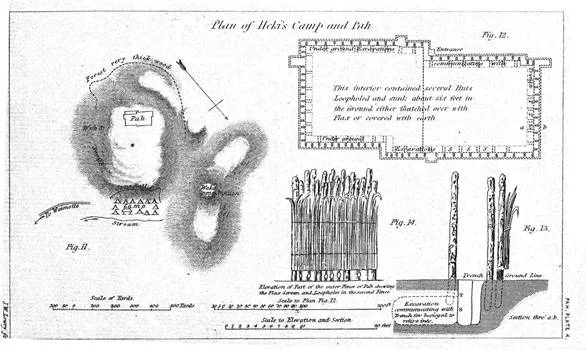
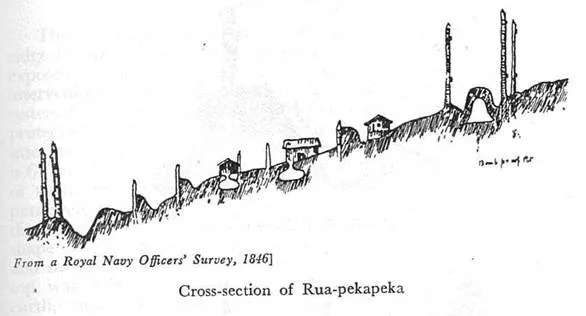
Kawiti built Ruapekapeka to be stronger than Ōhaeawai. He set pūriri trunks twenty feet long and three feet thick eight feet into the ground for the main palisade. Inside he raised no large buildings and dug underground rooms instead, each holding up to twenty men, which carried them through two weeks of bombardment. Martin writes that the defenders sheltered "like a colony of bats", and that the pā took its name, the bats' nest, from them.
On Sunday 11 January the troops walked into a pā that looked empty. Detachments had slipped away into the bush, where a defended position waited behind the pā, and Martin reads it as a feigned retreat meant to draw the soldiers after them. The British counted 45 casualties, and Māori about 30. Then the people left the pā, as they had left Ōhaeawai. Martin explains why: blood had flowed there, and no one would use it again. At the end of January Kawiti and Heke made peace. Martin writes that Kawiti pressed a kōtuku feather into the hat of the senior British officer, and that he made peace with Tāmati Wāka Nene.
Kawiti died at Waiōmio on 5 May 1854, aged about 80, and his son Maihi Parāone succeeded him. Before his death he told his people to hold fast to the treasures of their ancestors and wait "until the sandfly nips the pages of the book", and then rise. Maihi's people raised the Kororāreka flagstaff again in 1858.
Playthrough/The pā
Kawiti as the inventor of the gunfighter pa is a natural place to explore the pa building mechanics.
The start
In January 1810 Kawiti holds Waiōmio with about 275 Ngāti Te Tāwera. His father Hunā sits at Mōtatau, and Mataroria leads Ngāti Hine at Kawakawa. Ngāti Hine hold about 1,170 people in eleven kāinga across Ngāti Te Tāwera, Ngāti Hine ki Kawakawa, Ngāti Kōpaki, Te Orewai and Ngāti Moe, all in the southern grouping. I first gave Kawiti Kāretu as a second seat, but Ballara and the Kāretu marae make it a Ngāti Manu place, so it now sits with Ngāti Manu ki Kāretu. Kawiti's parents, his wife Kawa, their three sons and his brothers and sisters sit on the roster.
Ruapekapeka starts the game as an empty site. Ōhaeawai starts as a Ngāti Rangi kāinga with no pā. Neither place has its famous form in 1810, and the player who wants those pā has to build them.
Building
A pā in the game is a set of choices, and the choices widen over the period. The early works are palisades, ditches, fighting platforms, several enclosures inside each other, and secure water. From the 1840s the late works open up: angled earthworks, concealed rifle pits, covered trenches and gun emplacements. Each choice costs labour and time, and an upgraded pā should frighten its attackers before anyone fires a shot.
Martin's account gives me the design target. Kawiti built for a purpose, to draw the British onto ground of his choosing, and he sited the pā to make their approach slow. A good pā in the game should do the same work. It should make the enemy spend a month on the road, shelter its people from the guns, and leave them a way out into the bush.
Attacking
The attacker's options run the other way: escalade over the walls, bombardment, sapping toward them, fire, a siege to starve the defenders out, or talks toward a surrender. Each pā choice answers one of them. A stout palisade with firing positions behind it punishes an escalade, as Ōhaeawai did. Underground shelters blunt a bombardment, as Ruapekapeka did. In the game, meeting imperial commanders is what unlocks the late works.
Utu
Ngāti Hine's ledger runs long. Moremonui sits open from the first turn until Te Ika-a-Ranganui, eighteen years on. Waikerepuru in 1837 opens an account between Te Kapotai and Te Māhurehure, and in 1845 that account decides who guides the soldiers to Waikare. I want the player to watch old debts come due, with old enemies fighting beside the Crown.
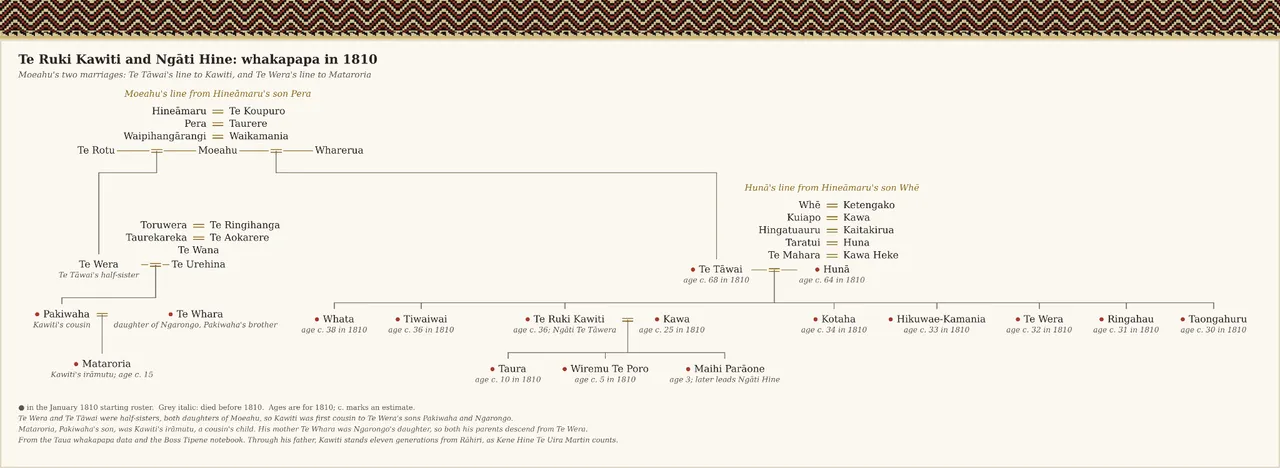
Image credits
· Portrait of Te Ruki Kawiti, 1940 centennial souvenir programme (detail). Archives New Zealand, IA54 Box 10/11. CC BY-SA 2.0, via Wikimedia Commons.
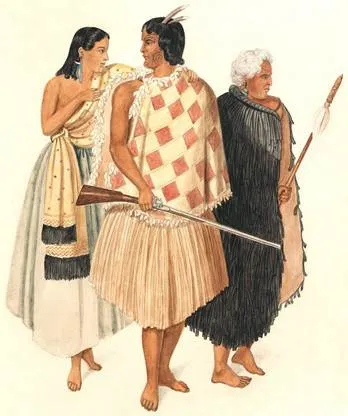
· Joseph Jenner Merrett, The Warrior Chieftains of New Zealand, 1846. Alexander Turnbull Library, C-012-019. Public domain, via Wikimedia Commons.
· William Biddlecomb Marlow, plan of Ōhaeawai pā, engraved by J. W. Lowry, 1860. Public domain, via Wikimedia Commons.
· Cross-section of Ruapekapeka, after a Royal Navy officers' survey of 1846, from James Cowan, The New Zealand Wars, vol. 1, 1922. Public domain, via Wikimedia Commons.
· Map and whakapapa chart: Taua data and base map.
Sources
· Kene Hine Te Uira Martin, "Kawiti, Te Ruki", Dictionary of New Zealand Biography, 1990. Te Ara.
· Te Kapotai hapū kōrero, Wai 1040 #D5, citing Erima Henare on Waikerepuru.
· Angela Ballara, "Pōmare II", Dictionary of New Zealand Biography, 1990. Te Ara.
· NZHistory, "Pī", He Whakaputanga signatories, for his death in June 1837.
· Archives New Zealand, notes to the Waitangi sheet of te Tiriti o Waitangi, for the May 1840 signing.
· James Cowan, The New Zealand Wars, vol. 1, 1922.
· G. A. Bennett and W. B. Marlow, Aide-Mémoire to the Military Sciences, 2nd ed., vol. 2, 1860.
· Boss Tipene whakapapa notebook, for the Ngāti Hine lines.
Comments