Korokoro
Korokoro of Ngāre Raumati held Pāroa, the anchorage the ships used most in the Bay of Islands' early years. In the years before 1820 he owned more muskets than any other rangatira in the north, and Marsden called him "Hongi's opponent." He died in 1823 and his brother Tuai a year later. Within three years their people had left Te Rāwhiti, and Kahuwera stood empty. This post is about a hapū caught between a strong neighbour and the sea, and how it tried to survive.
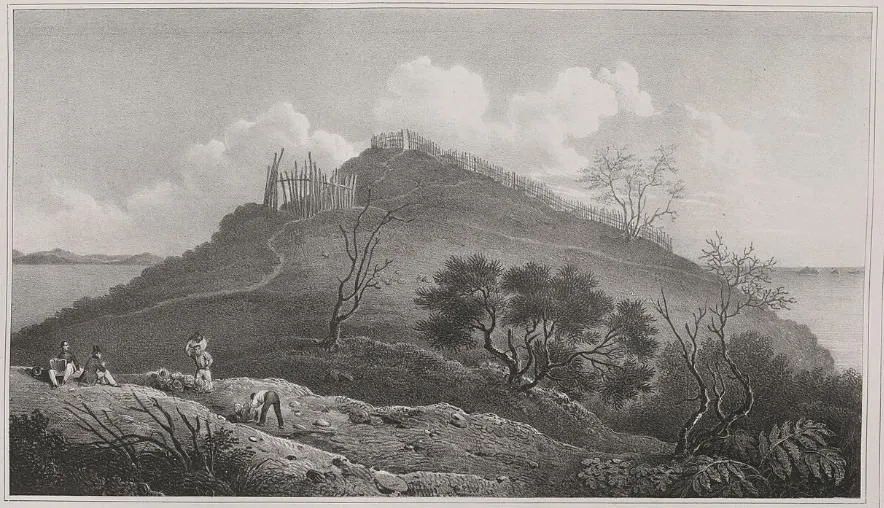
Hapū/Ngāre Raumati
Ngāre Raumati held the eastern Bay of Islands around 1810: Te Rāwhiti, Pāroa, Kahuwera, Manawaora and the islands of Moturua, Moturoa and Motuarohia. Ballara counts them as a people outside Ngāpuhi, and their small hapū included Te Parapowha and Te Tāwera, a Bay of Plenty group that had married in. Their allies ran down the east coast to Ngāti Wai and Te Parawhau. The Tribunal research report He Whenua Rangatira adds that Korokoro's own whakapapa was both Ngāpuhi and Ngāre Raumati, and that this let him keep Pāroa. Both readings are true at once, and the game has to hold both.
The war with Waimate began around 1800 over a woman. Te Hakiro of Ngāre Raumati had taken Whakahoe as a second wife, and Whitirua of Ngāi Tāwake took her from him. In the fighting that followed, Ngāre Raumati killed Te Maire of Ngāti Rēhia and then Te Auparo, the mother of Rewa, Te Wharerahi and Moka, as she worked in her garden. Her sons named their hapū Te Patukeha to remember her. Te Hōtete, Hongi's father, led the first answer, and the missionary John Butler later learned that Korokoro's father had died in a battle with Hongi's people. A second taua under Tapua of Ngāti Hao caught the Ngāre Raumati fleet off Tapeka, where Kira killed their chief Te Tāwheta, Korokoro's grandfather.
So in 1810 Korokoro's people carried accounts against Ngāi Tāwake, and Ngāi Tāwake carried accounts against them. Korokoro's grand-uncle Kaipō of Te Aki Tai was the senior man, and Kaipō's marriage to Raumati of Ngāti Rāhiri gave Ngāre Raumati kin among their enemies' allies.
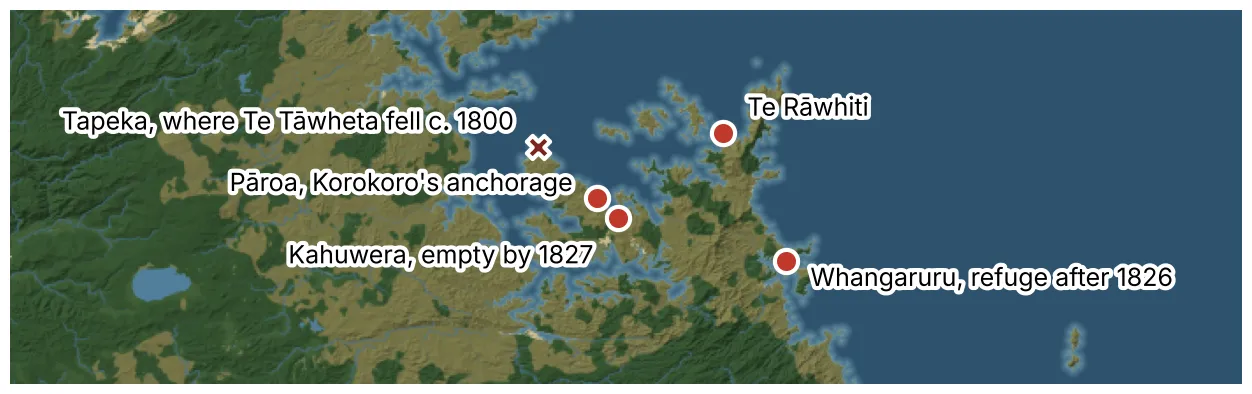
Rangatira/Korokoro and Tuai
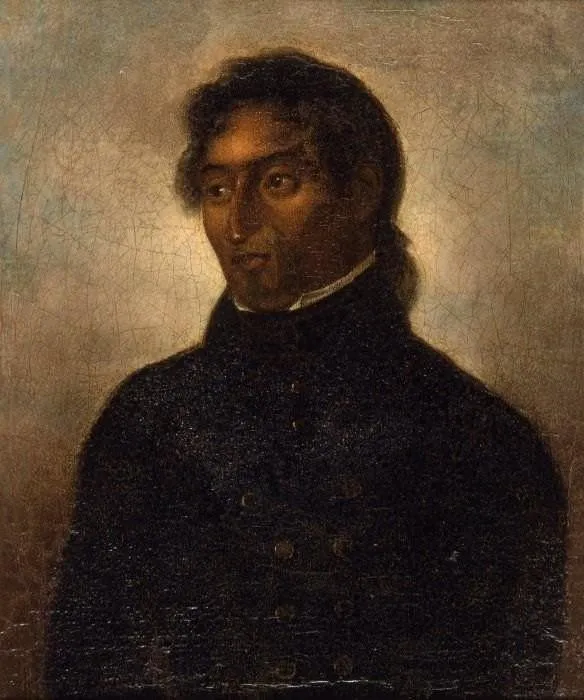
Korokoro built his position on the ships. Pāroa was the most used anchorage in the Bay in the early years, and Korokoro made it his. Ballara writes that he "owned more muskets than anyone else at this time because of his domination of the Paroa anchorage." In 1814 he sailed to Sydney on the Active with Ruatara and Hongi, and the visit helped bring Marsden's mission to the Bay. His younger brother Tuai went to England in 1818, and James Barry painted his portrait there that October.
Before 1820 Korokoro and Tuai's people traded and raided down the east coast to Hauraki. Korokoro sided with Te Haupa of Ngāti Pāoa against Ngāti Maru, and Te Haupa got some of his first guns from him. Kaipō's son died on one of those trips, and Korokoro's people put it down to mākutu. In September 1819 he planned a taua to Hauraki to answer for it, and first made a truce with Hongi so the Waimate people would leave his dependants alone while he was away.
The ships made him enemies as well as friends. The mission moved to Kerikeri in 1819, under Hongi's protection, and Korokoro told Marsden that Hongi would now "cut him off." In 1820 the Dromedary anchored at Pāroa, and Major Cruise noted that Korokoro treated the ship as his and kept his neighbours from trading with it. In 1822 Hongi's people stripped Korokoro's settlement of its potatoes in a taua muru, after Korokoro accused Hongi of stealing pigs he had raised for trade.
Korokoro died in 1823 and Tuai in 1824, and Ballara writes that their deaths left the people "without a strong leader." In April 1826 a taua from Waimate and Hokianga came for them. Rewa had long felt the utu for his mother and sister fell short, and he organised the taua against Hongi's wishes, with Tītore, Ururoa, Te Wharerahi, Moka and Mohi Tawhai of Te Māhurehure. They took the island pā Moturahurahu and then Motuoi. Three days in, a chief from Kerikeri swam out to the enemy pā and ended the war on condition that the people move to Kerikeri among Hongi's kin.
Many stayed away from Kerikeri. Ngāti Rāhiri took some people, and Te Whānau Tara others. Many withdrew south to their kin at Whangaruru, Whananaki and Matapouri. Others went to Waitangi, to Te Haumi with Tohitapu, and to Kawakawa with Te Koki. Rewa and Te Kohikohi then turned on Pāroa, but Te Hapetahi of Ngāti Rāhiri got there first and called out that the place was tapu, and that he was Pāroa. He meant the people of Pāroa were his to protect, through Raumati. Pāroa survived the day, but its people soon left. Dumont d'Urville found Kahuwera abandoned in 1827.
Playthrough/Keeping a hapū alive
Of the game's systems, I lean on survival hardest here. Ngāre Raumati start rich in ships and guns and short of friends, and they lose their land within a generation. A player should feel that clock from the first turn.
The start
In January 1810 I seat Korokoro at Kahuwera, which Ballara calls Tuai's pā, with about 555 people, and at Pāroa. Ngāre Raumati hold seven kāinga across the eastern Bay, close to 950 people together, and the game sets them apart from both northern and southern groupings. Kaipō, Tuai, Te Rangi and their mother Muritere sit on the roster.
My notes on Kahuwera say it "fell to Ngāpuhi" around 1827, and my opening post said Ngāpuhi took it. Ballara has it abandoned after the 1826 withdrawal. I've corrected the opening post and will fix the notes. The Boss Tipene notebook records a different line for Korokoro, with one more generation and Te Awhi as his mother, which I've noted on the chart.
Arm or ally
Under the utu rules, muskets cap how large an answer the weaker side can make, so its open debts keep growing. Under that pressure the weaker side arms, finds allies or seeks terms. Korokoro started with the arms. A Ngāre Raumati player begins with what the other Bay hapū want most, a busy anchorage and the guns that come through it, and the choice is how to spend that lead before Hongi's armoury passes it.
The kin rules decide who comes to help. Ngāre Raumati have kin down the east coast, and a few, through Raumati, among Ngāti Rāhiri. They have few among Ngāi Tāwake. A player who marries into the northern grouping, or builds on the Raumati tie, gains people who can mediate and abstain when Waimate comes.
Losing mana and land
The mana rules say that a hapū which loses mana and cannot restore it loses its independence and lives under another's mana. The terms of 1826 put that in plain words: move to Kerikeri among Hongi's people. The game models a client state between independence and destruction, and I want the player to see each path in the record. Some went to Kerikeri, some to kin on the coast, some to protectors at Waitangi and Te Haumi, and Te Hapetahi held Pāroa for a season through whakapapa.
Succession
Korokoro and Tuai died a year apart, and the hapū had no one of their weight to follow them. Succession is where a small hapū breaks. I want the death of a strong rangatira to weigh most on hapū with few allies, and a thin bench of heirs to show up as a risk long before the funeral.
If you hold kōrero about Ngāre Raumati, Korokoro or Tuai that differs from what I have here, I want to hear it.
Next up, and last in the series, is Te Ruki Kawiti of Ngāti Hine.
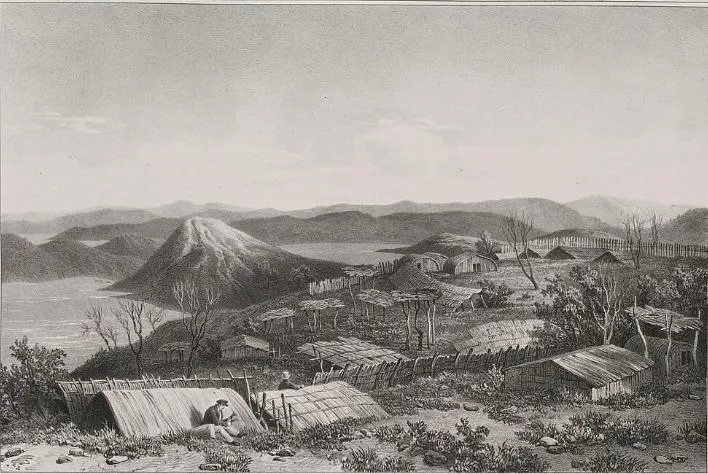
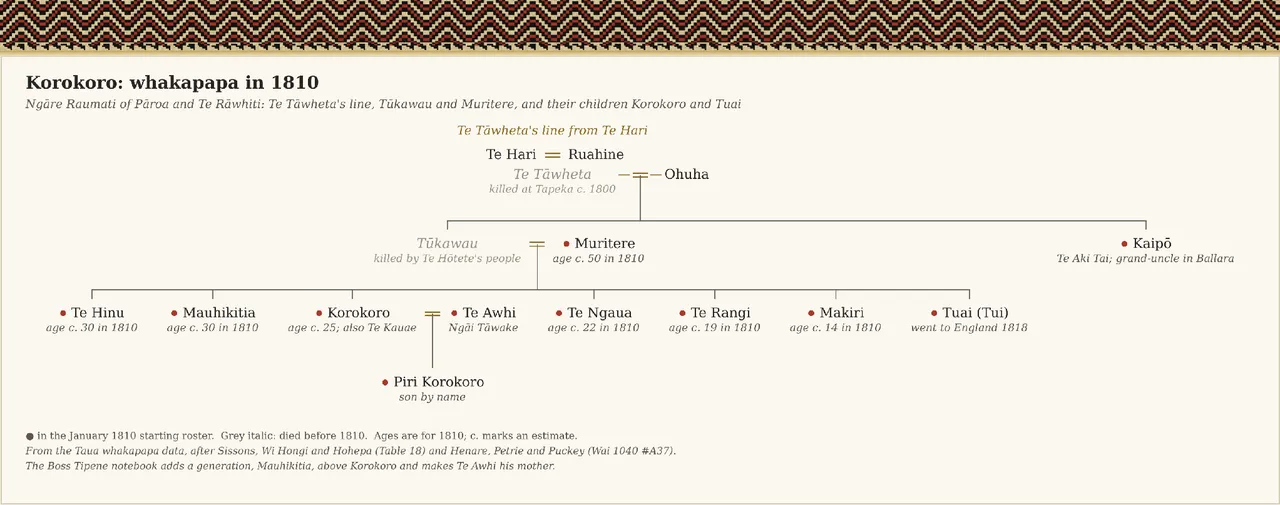
Image credits
- After Louis Auguste de Sainson, Vue de Kahouwéra and Vue intérieure du pâ de Kahouwera, lithographs by J. Tastu, 1833 (details). New York Public Library. Public domain, via Wikimedia Commons.
- James Barry, Tooi, a New Zealand chief, 1818. Alexander Turnbull Library, G-608. Public domain, via Wikimedia Commons.
- Map and whakapapa chart: Taua data and base map.
Sources
- Angela Ballara, Taua: "Musket Wars", "Land Wars" or Tikanga?, 2003.
- Henare, Petrie and Puckey, "He Whenua Rangatira", Wai 1040 #A37, 2009.
- Jeffrey Sissons, Wiremu Wi Hongi and Pat Hohepa, Ngā Pūriri o Taiamai, 1987.
- Richard Cruise, Journal of a Ten Months' Residence in New Zealand, 1823.
Comments