Pā, kāinga and the human map: in play
The last post covered what the data holds about pā, kāinga, gardens, tracks and the first Pākehā footholds. This one covers what they do once the game starts. I've written it as the life of a settlement, from empty ground to a pā under siege and back to scrub, and I've used Ngāti Hine for the examples.
Empty ground
In January 1810 Ruapekapeka is a ridge in Ngāti Hine country with no one on it. Kawiti won't build his pā there for another thirty-five years. Empty ground sits inside a hapū's rohe, and the people who hold the rohe hold the right to use it, settle it and defend it.
Ground that people have lived on before should show marks of previous settlement: old ditches, banks and garden terraces. Those old works make a site cheaper to settle again than fresh ground, and they give a hapū a reason to go back. Left long enough, they rot and the gardens go back to scrub, and the site becomes empty ground again.
Settling empty ground costs labour and a season. Settling it inside someone else's rohe is a claim on their land, and gives them utu against you.
Lived in
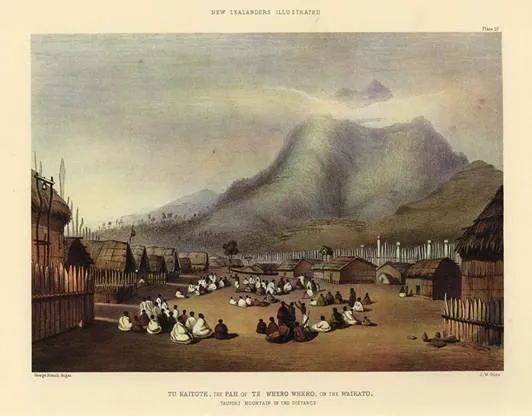
Waiōmio is Kawiti's seat in 1810, with about 275 people of Ngāti Te Tāwera around him. A lived-in settlement carries a few things: its people, its size, its gardens, its defences, a rangatira and, for a few, the mark of a principal seat. The people matter most. They work the gardens, build the walls, crew the waka and fill the taua, and every task draws on the same pool of labour.
A place counts as a pā or a kāinga according to its defences at that moment. A kāinga that digs ditches and raises a palisade becomes a pā, and a pā left to rot slides back. Across sixty years one site can be both several times.
The same rule lets whole hapū move. When a hapū leaves its land for the south, its old settlements empty, and it settles or takes new ones somewhere else. A player or the AI decides whether to make those journeys.
Feeding your hapu
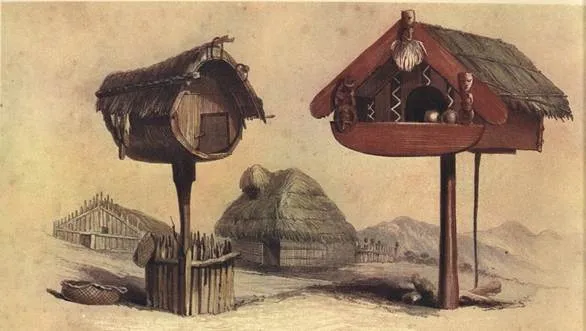
The game runs in months, and the months follow the food. Kūmara planting runs from September to November, and the harvest comes in March and April. Planting and lifting were tapu work, so the people you put on them stay there for the month. The gardens stay tapu until the crop comes up, and to trespass on them is a grievance.
Waiōmio's gardens sit on the flats and gentle slopes around it. The terrain decides how much ground a kāinga can crop and how well it grows. The resource sites within reach decide what else fills the baskets: eels from the weirs, birds in winter, fern root, fish from the river mouth. A hapū inland on the Taumārere eats to a different calendar from one on the coast at Whangaruru.
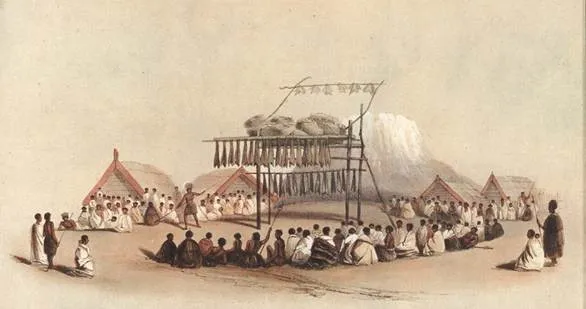
Fresh food feeds people through the month. Stored food carries them through the hungry months and pays for everything beyond survival: a hākari, a tangihanga, a taua. A taua of two hundred is two hundred people away from the gardens, so a war in planting season costs next year's crop. I want every choice about war to start as a choice about food.
Potatoes and pigs change that sum. Potatoes carry none of kūmara's tapu, they keep better, and captives can work them. A hapū that grows them frees people for war and trade. What the hapū does with that freedom is the player's call.
Reaching out
Every move across the map costs effort. Grassland and old garden ground are cheap to cross. Forest costs more, swamp more again, and rock and alpine ground most of all. Steep slopes raises every cost, and a track halves it. Crossing a wide river costs a great deal unless a track already runs across it.
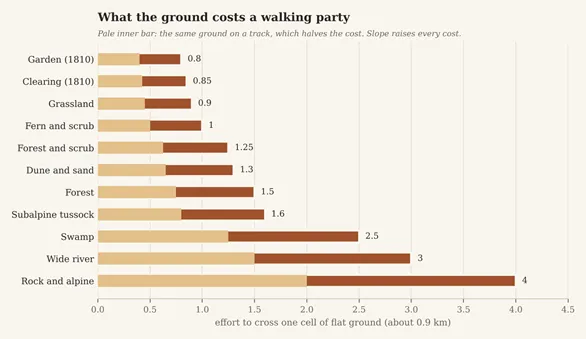
Waka are the most efficient form of travel. A river or a coastal lane carries a war party further in a day than any track, and a portage turns miles of bush into a short carry between waters. The same effort measure defines each hapū's territory. Each 1810 holding spreads across the land until the cost runs out, so borders follow ridges, swamps and big rivers. The map shows how far Waiōmio reaches on foot before the effort climbs too high.
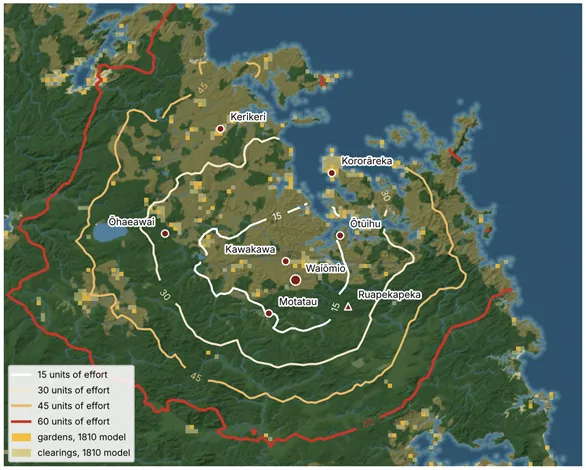
Every kāinga without defences knows its pā, the place its people run to when a taua comes. When the warning reaches Motatau, its people need somewhere strong within a day, and the game needs to know where. Moving through kin's land is easy. Moving through anyone else's land asks permission or picks a fight.
The coast and the ships
In 1810 the Boyd has burned at Whangaroa, meaning that most ships keep away from the north. Waiōmio sits inland, and its nearest anchorage is Ōtūihu, in Ngāti Manu hands. So an inland hapū reaches the ships through its kin.
I want anchorages to work as access. A hapū controls who reaches the ships, and that control is power. The goods that come ashore, muskets above all, run along the same tracks and rivers as everything else. A supply line from Waiōmio to the coast crosses other people's ground, so the neighbours along it matter.
Mission stations and traders arrive because a hapū invites them and builds them up. A rangatira who wants a missionary, a trader or a blacksmith has to work for one, and each brings goods, knowledge, disease risk and obligations. Later the Crown arrives the same way, and much harder to send home.
Fortifying
Defence requires labour. Ditches, banks, palisades and fighting stages all take people away from the gardens, and winter is the season for heavy work. A pā with water inside its walls and full stores can sit out a long siege. A pā without them can't.
The works open up over time. The older forms are palisades, ditches, fighting stages and enclosures inside enclosures. From the 1840s the new forms come in: angled earthworks, rifle pits outside the walls, covered trenches and shelters dug into the ground. They come from knowledge, carried home by travellers and by the people who meet the new guns. I wrote about Kawiti's pā in the last Ngāpuhi post. The aim here is the same: an upgraded pā should frighten the people who have to attack it.
Under attack
An attacker picks an approach. They can storm the walls, bombard and then storm, dig toward the walls, set the palisade alight, starve the defenders out, or talk. Each approach needs something: numbers, cannon, time, the right wind, food to wait on. Each kind of defence answers one of them. I want the siege to play as a contest between what one side built and what the other side brought.
The pā and its people are separate prizes. A taua can take a pā while its people slip away into the bush, or it can take the people and leave the pā standing. Either side can open talks at any point. A negotiated end costs less utu, and the defenders walk out with
Every fight leaves an account behind it. Utu from a fight below Ōtūihu in 1837 came due at Waikare in 1845, when the people who had lost guided British troops to Te Kapotai's pā. I want the utu ledger to carry a siege's cost well past the day it ends.
Leaving
Ruapekapeka emptied in January 1846. Blood had flowed there, so the people left it. In the game a pā that has seen exceptional bloodshed becomes tapu and passes out of use, so even a great defence costs the site. The ridge goes back to old works, then to scrub, and the cycle can start again.
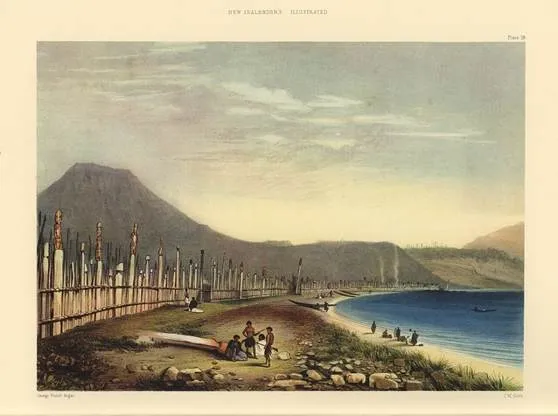
Image credits
· George French Angas, The New Zealanders Illustrated, London, Thomas McLean, 1847: Tu Kaitote, the pā of Te Wherowhero; Whatas, or patukas (detail); A feast at Matatā; Te Heuheu's old pā of Waitahanui. Public domain, via Wikimedia Commons.
· Diagrams and map: Taua data and base map.
Sources
· Elsdon Best, "Maori Agriculture", Journal of the Polynesian Society 39 and 40, 1930 and 1931.
· Kerry Keane, "Musket wars", Te Ara, the Encyclopedia of New Zealand.
· Kene Hine Te Uira Martin, "Kawiti, Te Ruki", Dictionary of New Zealand Biography, 1990.
· Te Kapotai hapū kōrero, Wai 1040 #D5.
Comments