Hongi Hika
Hongi Hika led Ngāpuhi through the first decade of the musket years, and his name reaches further outside the north than any rangatira of his time.
Hapū/Ngāti Tautahi and Te Uri o Hua
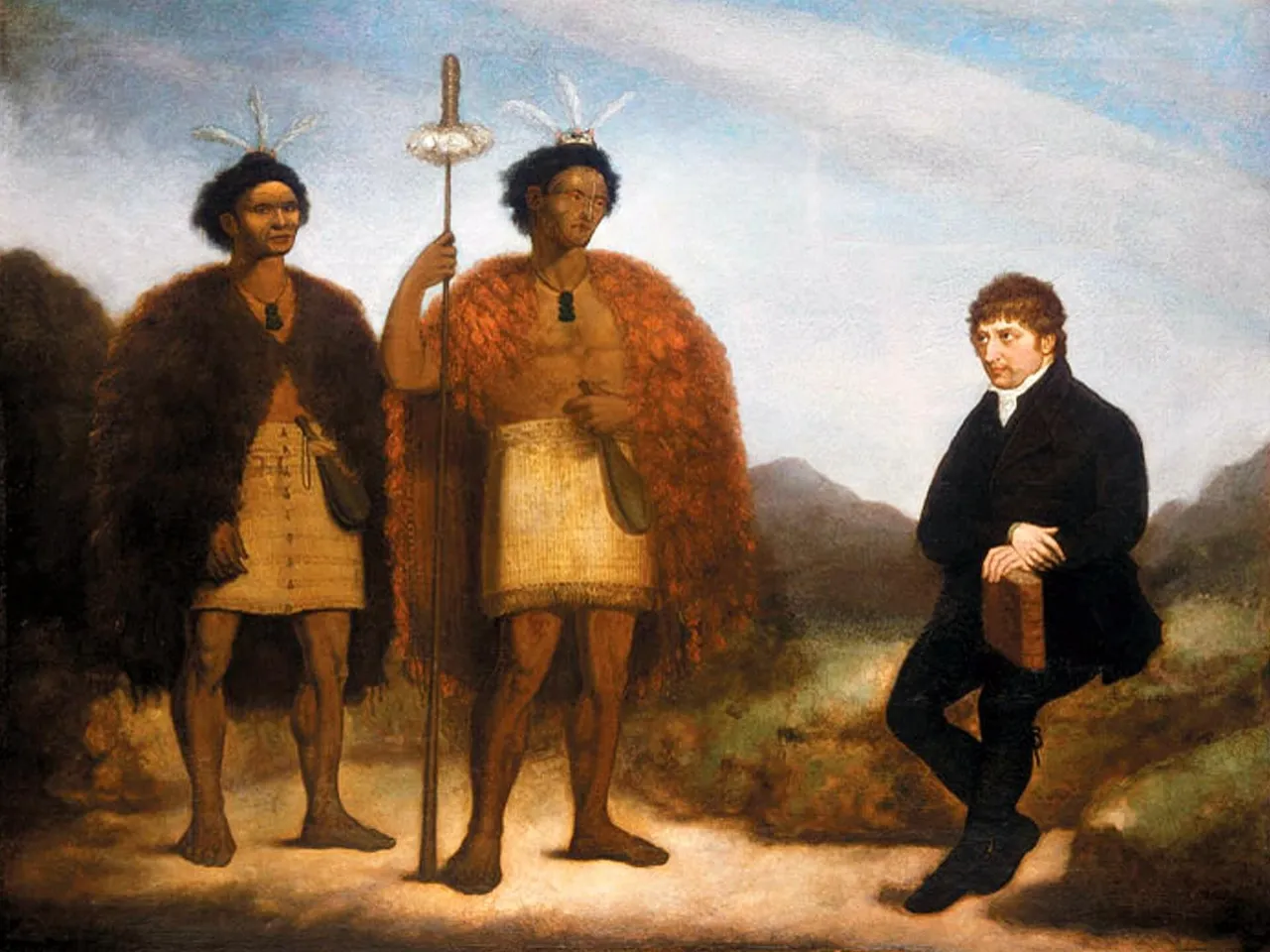
Ngāti Tautahi held the inland country between Kaikohe, Waimate and Kerikeri, part of the ground Rāhiri's descendants took as they moved east from Hokianga into the Bay of Islands. Their pā included Ōkuratope near Waimate and Kororipo, above the Kerikeri basin, where taua gathered their waka. They lived alongside Ngāti Rēhia and shared Kerikeri with them, and the two married into each other over generations.
Sources name Hongi's hapū in different ways. Angela Ballara's DNZB biography gives his closest affiliations as Ngāti Rāhiri, Ngāti Rēhia, Ngāti Tautahi and Ngāi Tāwake. Anne Salmond's map of Bay of Islands chiefs for 1805 to 1815 places his eldest brother Kaingaroa under Ngāti Tautahi and Te Uri o Hua, with lines to Kororipo and Ōkuratope. Other accounts count Hongi under Ngāti Rēhia through his mother. A rangatira of his rank drew on several lines, and the one he stood on shifted with where he was and who he dealt with.
Moremonui shaped the hapū in 1810. In 1807 or 1808 a Ngāpuhi taua went south against Ngāti Whātua, and Murupaenga caught it on the coast near Maunganui Bluff while its musketeers reloaded. The war leader Pōkaia died there, Hongi's uncle, along with two of Hongi's brothers. Te Hōtete, Hongi's father, died soon after, in the roster's estimate around 1809. In January 1810 the hapū had a new war leader, an ariki in Kaingaroa, and a debt to Ngāti Whātua it had not yet answered.
One Whangaroa account ties a hapū to that debt. It has Hongi, Te Hau and Ururoa founding Te Tahaawai after Moremonui in memory of a sister killed there, and carrying the name north by conquest. Another account has Te Tahaawai as an older Whangaroa hapū. I've recorded both and picked neither.
In December 2025 Parliament passed the law returning Kororipo to Ngāpuhi, with Ngāti Rēhia as kaitiaki. Heritage New Zealand lists it as a wāhi tapu area under Ngāti Rēhia. Ngāti Rēhia speak for the pā today, and anything Taua shows of it goes through them first.
Rangatira/Hongi Hika
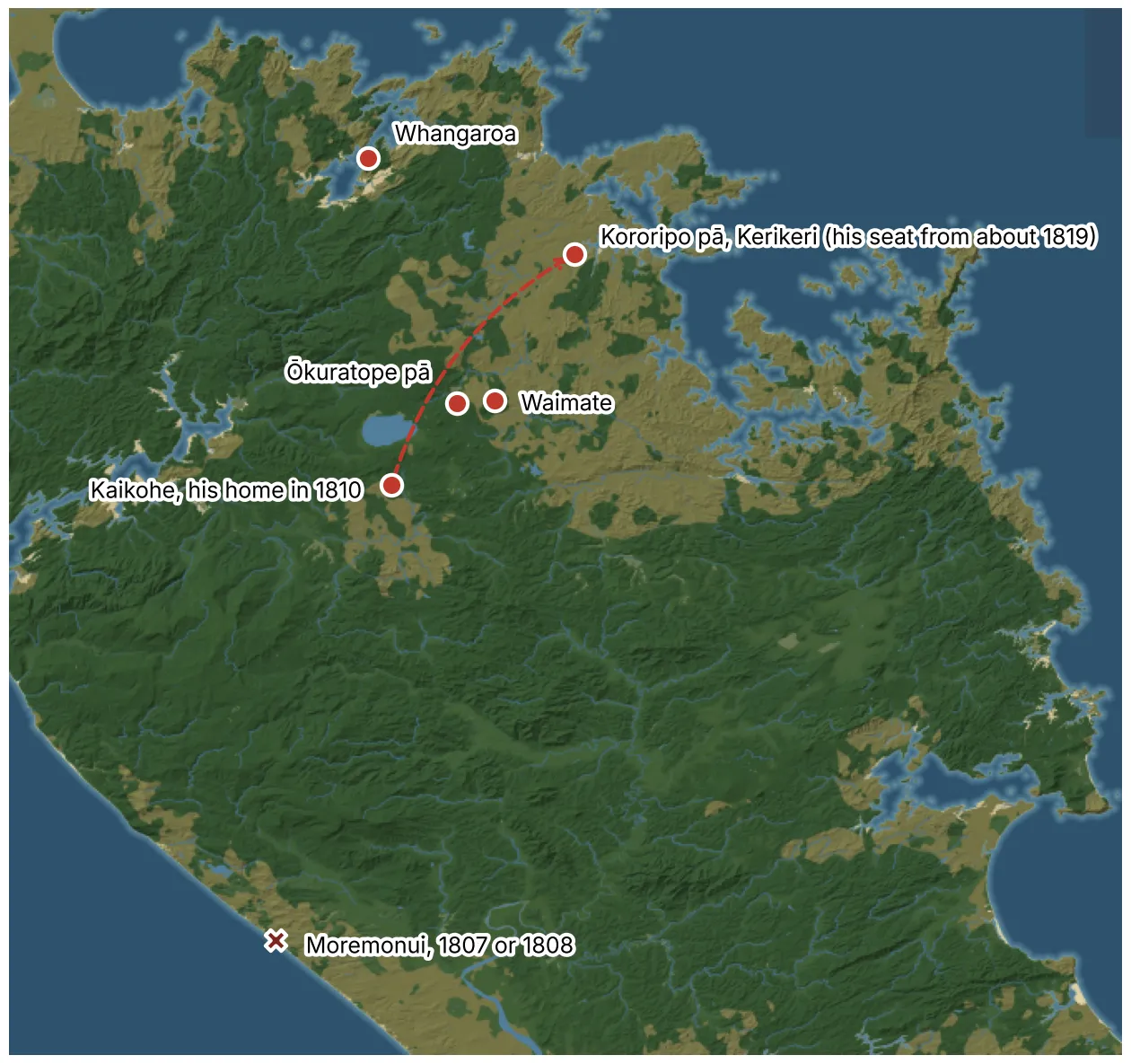
Hongi was born near Kaikohe. He told French visitors in 1824 that he was born in 1772, the year Marion du Fresne died in the Bay of Islands, and most accounts follow him. He was the third son of Te Hōtete and his second wife Tuhikura of Ngāti Rēhia, and Ballara traces him nine generations from Rāhiri.
Through Tuhikura he was first cousin to Ururoa and Te Hau of Whangaroa. His two leading wives, Turikatuku and her sister Tangiwhare, were their sisters. Turikatuku went blind and still travelled with him on campaign as his adviser. That web of cousins and wives pulled Whangaroa into the last years of his life.
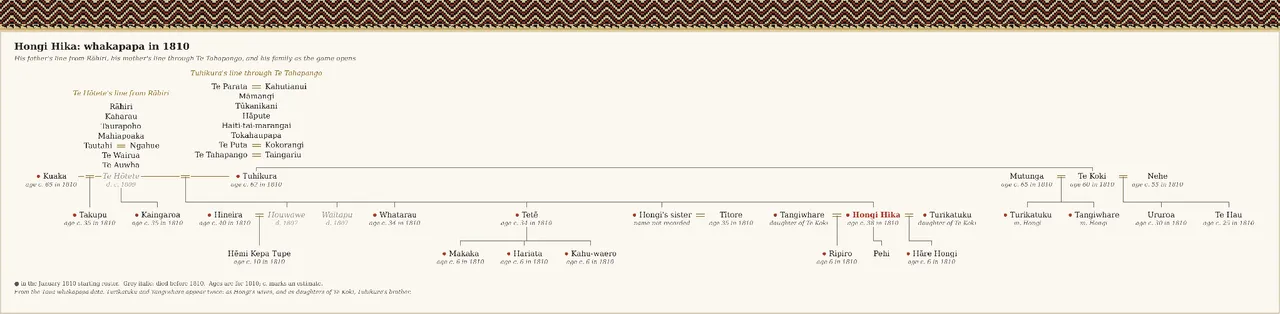
In January 1810 Hongi was in his late thirties. Kaingaroa held seniority until his death in 1815, and Hongi's standing came from war. Ballara has him taking Pōkaia's place after Moremonui, where he survived by hiding in a swamp. His campaigns against Te Roroa, Te Rarawa and Te Aupōuri in the years after taught him that muskets counted in numbers, and that a few guns could cost a taua more than they won. In 1810 the north had few muskets, and the Boyd had scared off the ships that sold them.
He lived inland then, at Kaikohe and around Ōkuratope. He moved his seat to Kororipo around 1819, when the Church Missionary Society built at Kerikeri under his protection. Missionaries described him at home as mild and courteous, working his own gardens and going out fishing with his people. One Whangaroa source says he "was himself a tohunga", and he cut musket shot out of wounded men and dressed their wounds.
The eighteen years after 1810, from Ballara:
- 1814: Hongi sailed to Sydney on the Active with Ruatara and Korokoro. The visit helped bring Samuel Marsden's mission to the Bay that December. Hongi protected missionaries and seamen because a safe anchorage drew ships, and ships carried iron, powder and guns.
- 1815: Kaingaroa died, and Hongi led his people without a rival.
- 1818: Hongi and Te Morenga led separate expeditions south. Captives worked his enlarged gardens, and he traded the potatoes for muskets.
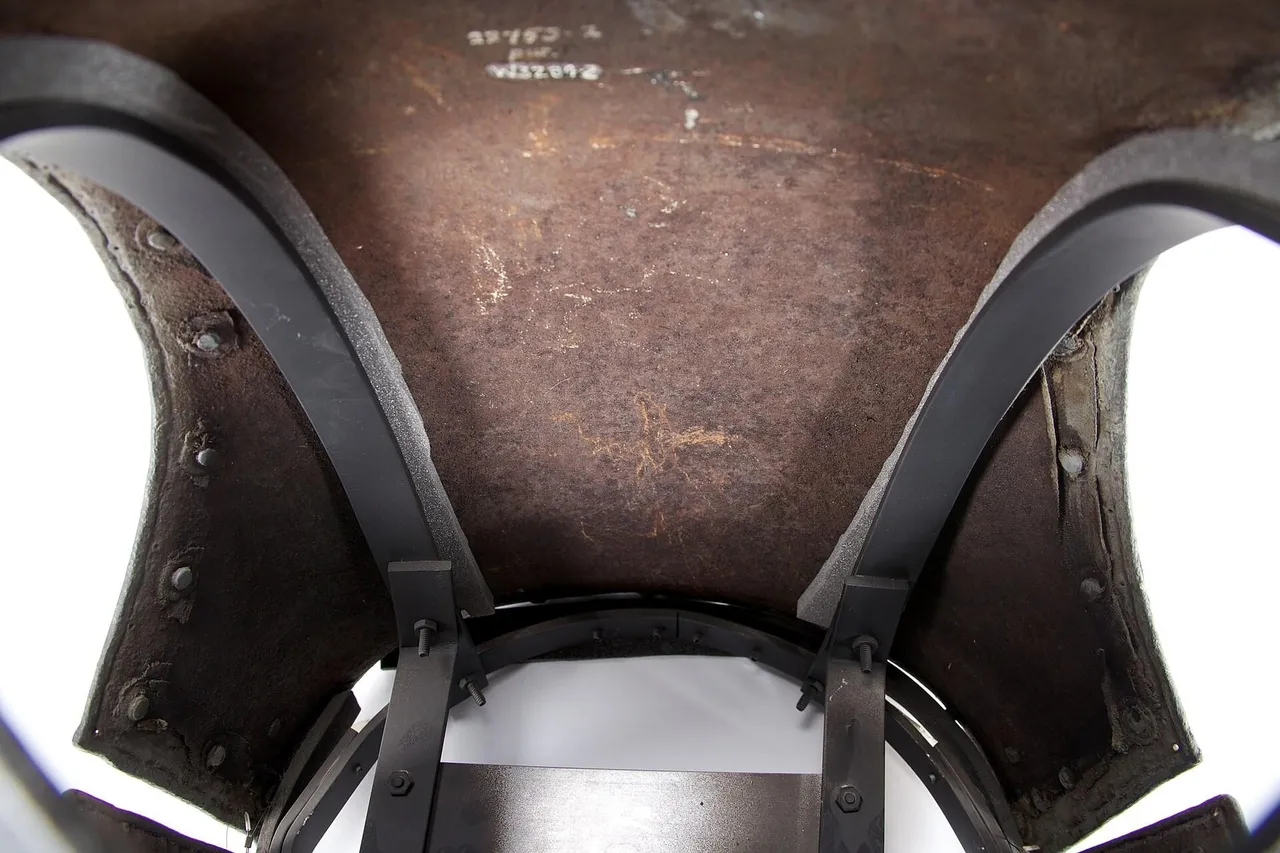
- 1820: Hongi went to England with Thomas Kendall and the young Te Hikutū rangatira Waikato. At Cambridge they worked with Professor Samuel Lee on a grammar of te reo. George IV received him and gave him a suit of armour, and he came home through Sydney with the muskets he'd gone for.
- 1821 to 1823: he led taua against Mauinaina at Tāmaki and Te Tōtara near the Thames in 1821, Matakitaki in Waikato in 1822, and Mokoia Island in Rotorua in 1823, hauling waka overland to reach it.
- 1825: Ngāpuhi defeated Ngāti Whātua at Te Ika-a-Ranganui, near Kaiwaka. His eldest son Hāre Hongi died there, and his grief stayed with him.
- 1827: a musket ball went through his chest at Whangaroa. Turikatuku died a few days later.
- 1828: he died of the wound at Whangaroa on 3 March.
Ballara makes two points I'm holding the game to. Accounts inflate the casualty figures, and Hongi himself put the Ngāti Whātua dead at Te Ika-a-Ranganui at about 100, against claims of 1,000. He also didn't set out to take and hold the lands he raided. He fought inside the frameworks of utu and mana, and he didn't plan the losses and migrations that followed.
Playthrough/Muskets and the cost of expansion
Ngāti Tautahi is a Tier 3 start, and the one start I've marked Expert. It has the strongest military position in the north and the hardest politics, with the highest mana ceiling in the game and the most attention from other hapū. The system it leans on most is the musket trade, and the bill that arrives with each expedition.
The start
In January 1810 I seat Hongi at three places: Te Uri o Hua's kāinga at Kaikohe, his home, and the Ngāti Tautahi kāinga at Kerikeri and Pukaka. Ngāti Rēhia hold rights at Kerikeri too. The three come to about 380 people, which is my estimate, not a recorded figure. The design document calls this the Kerikeri start, but the player begins inland, and the move to the coast is theirs to make.
The roster carries Kaingaroa as ariki, with the higher base mana that seniority gives, and Hongi as war leader. Turikatuku, Tangiwhare and Hāre Hongi are there with him, sixteen named people of the hapū in all. Hongi starts with high mana from his whakapapa and plenty of room to grow it. The split between ariki and war leader is the first test of the request system, since Hongi can't order his elder brother and the hapū weighs both men.
Ships before guns
Moremonui opens on the utu ledger as an account against Ngāti Whātua. Under the utu rules an open account costs no mana while the holder waits for the means, and in 1810 Ngāti Tautahi has none. A few muskets lost Moremonui, and the Boyd stopped the ships. So the first decade turns on contact. The player has to bring ships back to the Bay, make the anchorage the one captains trust, and grow the food and flax they'll pay for. The mission matters in this start for that reason. Hongi protected Marsden's people for the shipping they drew, and the game rewards the same trade.
Muskets come through that trade, with no fixed arrival date. The price moves with supply, and Hongi's rivals in the Bay want the same ships. Other rangatira complained to Marsden that Hongi kept the trade to himself, and Pōmare's hapū in the southern grouping work the same anchorages.
Campaigning
Once the guns arrive, the start opens up. Haerenga taua can reach Tāmaki, Hauraki, Waikato and Rotorua, and each victory adds deeds to Hongi's mana. Each one also writes an account into the ledger of the hapū he raided, and they'll carry it until they can answer. Muskets spread south through the 1820s, and the debts come back armed.
The Unification path in the design document starts here. It asks the player to turn military advantage into a confederation, with peace-making and marriage turning old enemies into partners. Deed decay works against it, because the mana of the 1820s fades by the 1860s unless the player builds on it.
Hongi's own life shows the other ending. He reached the top of the mana ladder, then lost a son, a wife and the backing of some of his people, and died of a wound from Whangaroa with a Waikato expedition still planned. I don't script that outcome. I want the systems to lead there if the player plays him the way he played.
Image credits
- James Barry, The Rev. Thomas Kendall and the Māori chiefs Hongi and Waikato, 1820. Alexander Turnbull Library, G-618. Public domain, via Wikimedia Commons.
- Backplate from armour said to have belonged to Hongi Hika. Auckland War Memorial Museum Tāmaki Paenga Hira, 1936.252.4. CC BY 4.0, via Wikimedia Commons.
- Map and whakapapa chart: Taua data and base map.
Sources
- Angela Ballara, "Hongi Hika", Dictionary of New Zealand Biography, 1990.
- Angela Ballara, Taua: "Musket Wars", "Land Wars" or Tikanga?, 2003.
- Dorothy Urlich Cloher, Hongi Hika: Warrior Chief, 2003.
- Anne Salmond, Between Worlds: Early Exchanges between Maori and Europeans, 1773 to 1815, 1997.
- Whangaroa evidence and Native Land Court minutes in the Harris brief (Wai 1040, #E32) and Hape's evidence on Pupuke.
- Heritage New Zealand Pouhere Taonga, Kororipo, List No. 7598.
- Tohu Whenua, "Kororipo Pā: The return of a historic landmark", 2026.
Comments